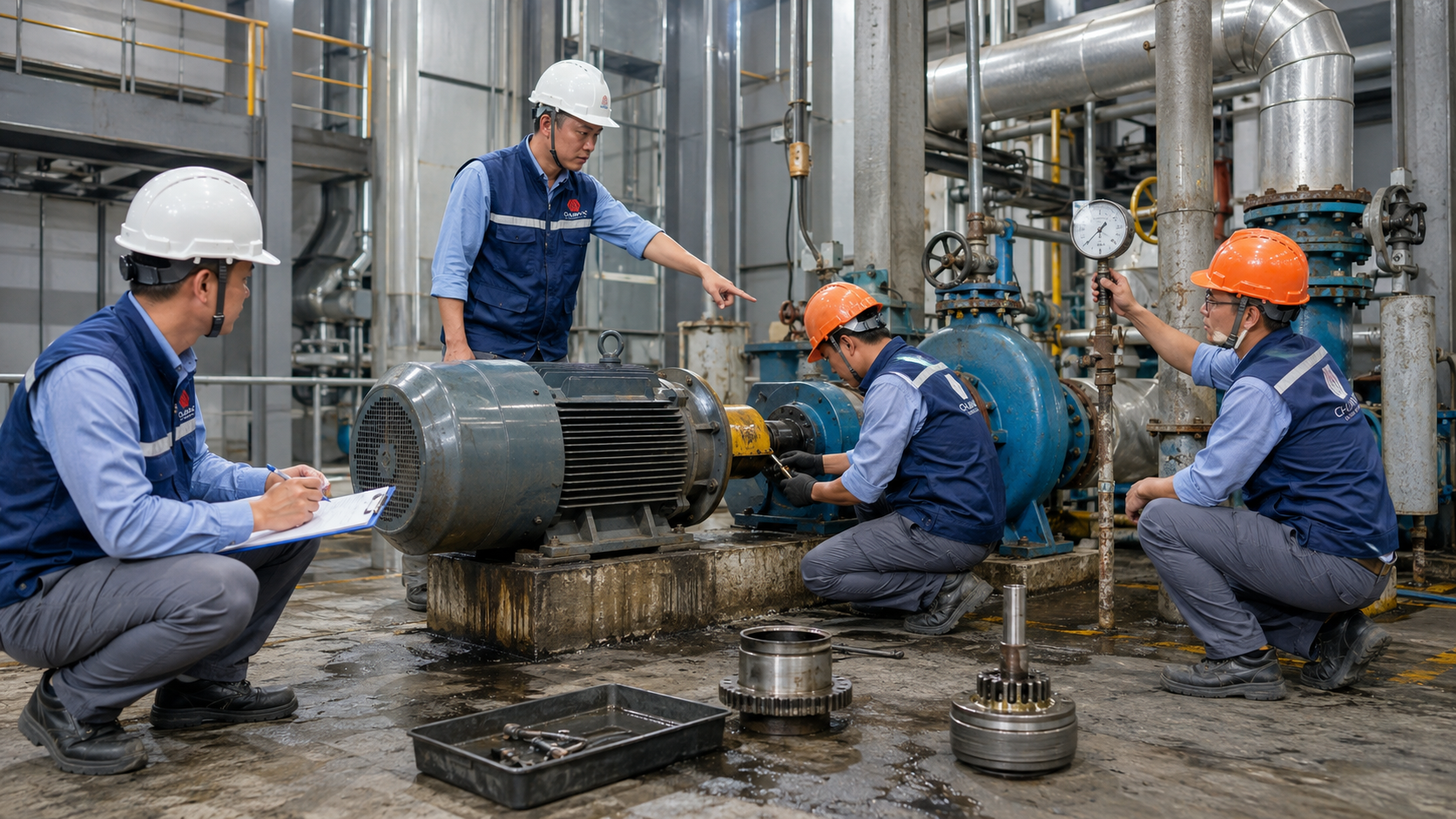
In today's fiercely competitive industrial landscape, any disruption to a factory's production process carries a colossal financial burden. Studies consistently show that unplanned downtime can cost businesses up to 10 times more than regular preventive maintenance. This is why the early detection of degradation in machinery, structural components, and M&E systems is a mission-critical factor for preventing severe accidents and production halts.
An intelligent industrial maintenance strategy doesn't just minimize major repair expenses; it also keeps operational performance stable, extends asset lifespan, and safeguards your workforce. Below are 10 warning signs that businesses in Dong Nai and surrounding regions must never ignore, signaling an urgent need for an immediate inspection and factory repair intervention.
(1).png)
These are often the earliest and most detectable signs. High-pitched squeals, metallic scraping, or abnormal vibrations from drive units, cooling fans, or compressor belts are clear warnings of severe wear, dry or failing bearings, or loosening fasteners over time. If timely industrial servicing is not performed, these components can shear off suddenly, causing catastrophic motor shaft breakage, or worse—generating enough friction to trigger localized fires.
The metal roof is your factory's most critical protective shield. The appearance of orange-red corrosion spots, especially at overlapping seams and where the roof sheets meet the purlins, indicates that the zinc coating has been compromised by harsh chemicals or the acidic environment typical in manufacturing plants. This is one of the most common causes of roof leakage, directly jeopardizing production lines, electrical systems, and stored inventory. Additionally, fasteners that loosen due to thermal expansion cycles compromise the structural integrity of the seams. Roof leak repair is only cost-effective when businesses address these early rust and loose screw signs before rainwater begins to intrude.
This is a "red alert" signal for your entire facility's operation. Conductors, busbars, or terminal connections that generate heat well above normal operating temperatures often result from overloaded circuits, loose connections (creating high contact resistance), or aged, brittle insulation on power cables. A noticeable burning smell from electrical panels or switches is a critical emergency indicator of imminent electrical arcing or short circuits. Businesses must immediately isolate this area, utilize thermal imaging cameras to spot hot spots, and assign highly skilled technicians to fully audit the entire factory electrical maintenance system.
.png)
Fire protection systems are mandatory, yet many businesses only pay attention to them when inspectors arrive. Signs such as clogged sprinkler heads caused by pipe scale, fire extinguishers with expired seals and pressure gauges, weak water pressure valves unable to reach higher floors, or a central alarm panel that frequently triggers false alarms are all clear indicators that fire protection maintenance has been seriously delayed. This is a non-negotiable critical safety category and requires independent, quarterly inspections by certified professional contractors.
Hairline "spiderweb" cracks on concrete floors or yellowish stains and mold growth rising from the base of the perimeter walls aren't just cosmetic issues; they signal severe structural problems. This points to blockages in the underground drainage system, or leaks from pressurized water supply lines running beneath the earth. Water seeping into the concrete will corrode the embedded rebar, drastically reducing the load-bearing capacity and potentially leading to localized foundation settlement.
When your HVAC units take much longer to cool the factory floor and consume noticeably more electricity to reach the required temperature set-point, there's a performance problem. The underlying causes are usually heavy industrial dust clogging the heat exchanger coils, air filters that are 100% blocked, or tension belts that have stretched to the point where blower fans can't run at full capacity. Regular maintenance of this equipment group not only cuts monthly energy bills significantly (by up to 20-30%) but also ensures a standard, comfortable, and safe working environment for all employees.
After a heavy downpour, if you observe standing water pooling on the roof surface without draining rapidly through the downspouts, it is a clear sign of severe blockage. Leaves from nearby industrial zones, production waste carried by the wind, or stray construction debris from past repairs all accumulate, causing the rainwater drainage system to fail entirely. The inevitable consequence is water overflowing into the factory through tiny gaps in the roofing, triggering localized flooding in warehouse areas.
Rolling shutter doors, sliding safety gates, or ventilation louvers that jam, are difficult to open or close, and emit piercing screeching noises indicate that hinges, track rollers, or drive motors are severely degraded due to lack of lubrication or advanced corrosion. This issue not only wastes workers' time entering and leaving but also directly compromises the factory's ability to keep out external dust and ensures security.
You should regularly inspect sensitive points such as pump bases, compressed air pipe couplings, or the footings of main load-bearing beams. Minor cracks or "spiderweb" fractures on concrete surfaces or separation of technical rubber adhesives indicate that load limits are being exceeded, or the foundation is experiencing uneven settlement. This is a signal to immediately implement a detailed structural repair plan to prevent serious collapses or pipe bursts that waste valuable raw materials.
If equipment, pipelines, or roofing continuously develop minor faults—only to break down again days later within a short time frame—it is an overarching sign that your maintenance program is failing. The useful life of these components has expired, and they are entering the "wear-out" phase. At this stage, businesses must conduct a comprehensive, data-driven factory maintenance audit that analyzes historical failure data. This allows for a full reassessment of maintenance cycles and the implementation of a synchronized spare parts replacement plan to break the vicious cycle of costly, reactive repairs.
Detecting these 10 warning signs early doesn't just let businesses fix minor, low-cost issues promptly; it effectively prevents large-scale production disruption. A professionally structured factory maintenance process that integrates both preventive and predictive maintenance will optimize operational costs and double the useful lifespan of your facility compared to reactive models.
A site survey identifies which items require servicing, where the installation has diverged from the original design and which areas should be prioritised.
CHUAN A CONSTRUCTION INVESTMENT CORPORATION
Address: Amata Industrial Park Service Centre, Long Binh Ward, Dong Nai Province, Vietnam.
Hotline: 0907 494 549
Email: info@chuana.com.vn
Website:https://chuana.com.vn/
Contact Chuan A to discuss fire protection system surveys and maintenance for factories in Dong Nai.


