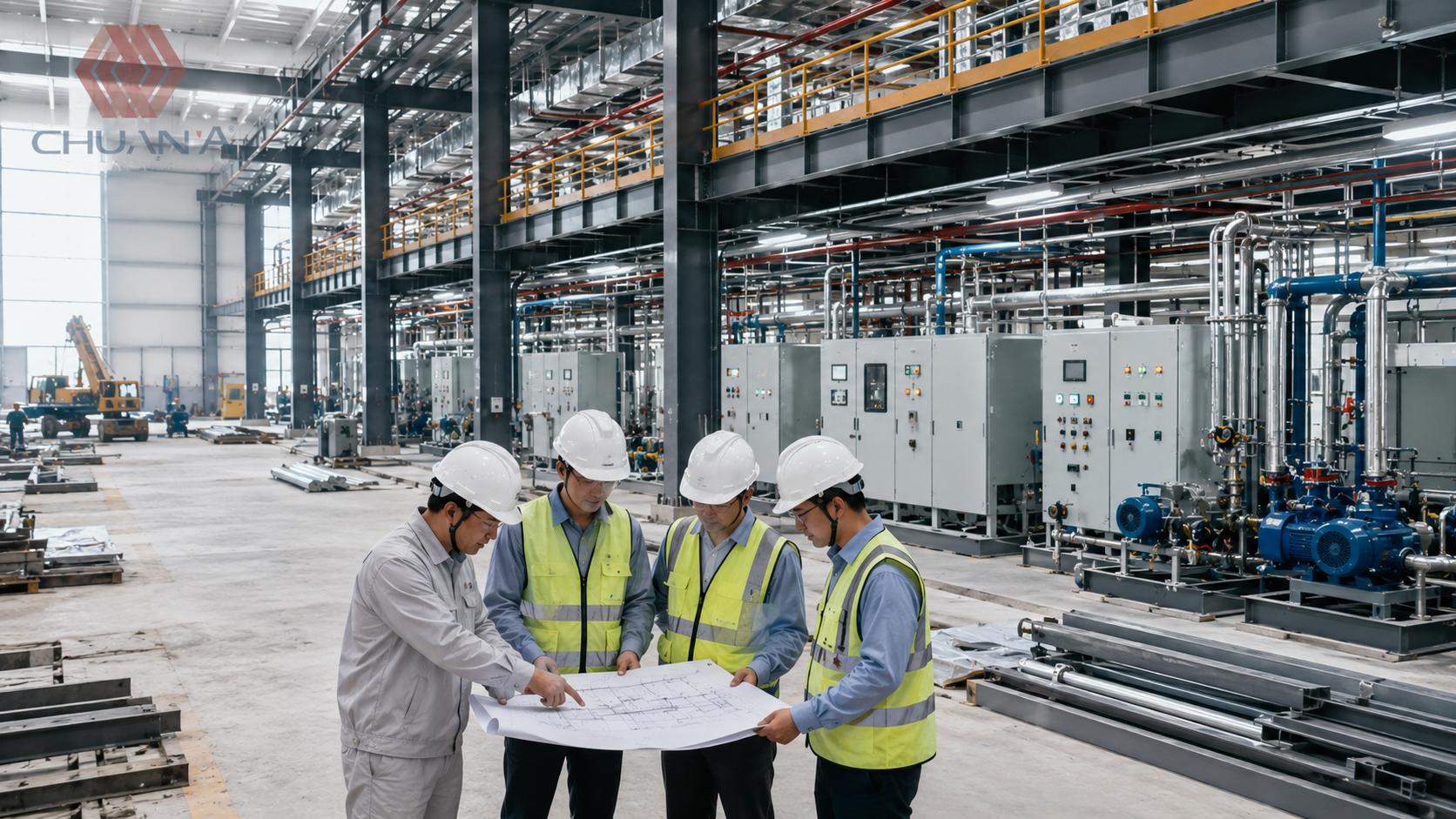
Industrial construction is a complex process that includes many connected work items forming a facility that can operate safely, efficiently, and reliably. A factory, manufacturing plant, or logistics warehouse is not only foundation, columns, roof, and walls. It is a full system of structure, flooring, building envelope, M&E, fire protection, infrastructure, offices, yards, internal roads, and technical documents for long-term operation.
For investors, understanding the key work items in industrial construction helps control the project better. When businesses know what the facility includes, they can review quotations more accurately, compare contractors more fairly, reduce missing work scope, and actively inspect quality during construction.
As industrial zones in Dong Nai, Binh Duong, and key economic regions continue to expand, demand for modern factory construction is increasing. Businesses do not only need a facility completed on schedule. They need a production space that meets technical requirements, ensures fire safety, optimizes operating costs, and supports future expansion.
(1).png)
Site survey is the first step and the foundation of the entire industrial construction project. Before design or quotation, the contractor must understand the land, construction conditions, existing infrastructure, access roads, power supply, water supply, drainage system, ground elevation, and surrounding factors.
For new projects, survey work helps identify real construction conditions. For renovation or factory expansion projects, the survey also helps assess existing structure, floor, roof, cladding, M&E systems, fire protection, and the level of impact on ongoing production. If the survey is superficial, the project can easily face issues during construction.
After the survey comes investment consulting. The contractor should listen to the investor’s requirements regarding function, area, production type, machinery, load capacity, storage needs, workforce, expansion plan, and estimated budget. From there, the industrial construction company can propose a suitable solution instead of offering a generic drawing.
Survey and consulting are like diagnosis before treatment. If the diagnosis is wrong, all later decisions may drift off track. Therefore, investors should spend enough time on this stage, especially for projects with high technical requirements.
Master planning determines how the facility is arranged on the land. In industrial construction, master planning is not only about the factory location. It also includes internal roads, yards, container areas, gates, guard houses, offices, warehouses, technical zones, fire protection areas, stormwater drainage, greenery, and supporting areas.
The functional layout inside the factory is equally important. Production areas, raw material storage, finished goods storage, packing zones, quality control areas, technical rooms, restrooms, pedestrian routes, and forklift routes must be arranged properly. A good layout reduces movement time, limits conflicts between people and vehicles, improves production efficiency, and reduces accident risks.
Many operational problems after handover begin with an unsuitable layout. For example, receiving doors may be in the wrong location, warehouses may lack height, forklifts may not have enough turning radius, offices may be too far from production areas, or escape routes may be affected by storage arrangement. These issues may not be obvious on drawings, but they create daily inconvenience during operation.
Therefore, before moving into detailed technical design, investors should review the layout carefully with the contractor. The question is not only whether the facility looks good, but whether it can operate smoothly.
The foundation is a critical load-bearing part of an industrial facility. It is not clearly visible after completion, but it determines the durability, stability, and safety of the factory. An unsuitable foundation may cause settlement, cracking, tilting, structural damage, and production interruption.
The foundation solution depends on soil conditions, building load, machinery load, factory height, structural type, and operating requirements. Depending on the project, the contractor may recommend isolated footings, strip foundations, pile foundations, weak soil treatment, or suitable reinforcement solutions.
For industrial projects, loads do not only come from the building itself. Heavy machinery, forklifts, storage racks, goods, hanging equipment, tanks, or production lines can create significant loads. Therefore, machinery and operational information should be provided from the beginning so engineers can calculate accurately.
Investors should not treat the foundation as a place for careless cost cutting. Saving in the wrong place at the foundation stage can become a large repair cost later. In industrial construction, what lies underground often keeps the entire production dream standing above it.
.png)
The main structure is the load-bearing frame of the facility, including columns, beams, trusses, steel frames, slabs, load-bearing walls, or other structural components. In industrial construction, the structure must meet requirements for span, height, load capacity, durability, equipment hanging ability, and future expansion flexibility.
Today, pre-engineered steel buildings are widely used in factory and industrial warehouse projects because they offer fast construction, wide open spaces, and easy expansion. Steel components are fabricated in a factory and then transported to the site for installation. This helps reduce on-site construction time and improve component quality control.
However, not every project uses only steel structure. Some facilities may use reinforced concrete, mixed structure, or special solutions depending on function. The important point is that the structure must match production activities, load requirements, budget, and long-term use.
When evaluating structural work, investors should pay attention to material quality, fabrication standards, connections, bolts, welds, protective coating, installation methods, and safety inspection. The structure is not only the backbone of the facility. It is also the rhythmic frame for the entire operating system inside.
Industrial flooring is directly affected by daily production activities. Forklifts move across it, machinery operates on it, goods are stored on it, employees walk on it, and technical equipment depends on it. Therefore, factory flooring must be designed and constructed properly.
A good industrial floor must have suitable load capacity, flat surface, low dust, easy cleaning, crack resistance, abrasion resistance, and suitability for the production industry. For logistics warehouses, flatness and surface durability are especially important because forklifts operate continuously. For food, pharmaceutical, or electronics facilities, flooring may also require dust control, anti-slip properties, easy cleaning, or specific hygiene standards.
Flooring solutions may include power-troweled concrete, epoxy coating, hardener, dustproof coating, anti-slip coating, or specialized finishing layers. The right solution depends on function, budget, operating environment, and business standards.
Many factories discover cracked, dusty, sunken, or unsuitable floors only after operation begins. At that point, repair often interrupts production. Therefore, investing correctly in flooring from the beginning is a way to protect the steady rhythm of factory operation.
Roofing, wall cladding, and the building envelope protect the production space from sun, rain, wind, dust, and environmental impact. This work item directly affects indoor temperature, building durability, leak prevention, cooling cost, and worker comfort.
In industrial construction, roofs and walls often use metal sheets, panels, insulation materials, heat-reduction layers, or envelope solutions suitable for the facility function. A general production factory may need a different solution from a cold storage warehouse, food plant, mechanical workshop, or logistics warehouse.
The building envelope must be designed to reduce leakage, drain roof water effectively, reduce heat absorption, support ventilation, and provide suitable lifespan. Doors, rolling doors, loading doors, daylighting panels, ventilation louvers, and details at roof-wall-gutter connections must also be handled carefully.
A good roof and wall system does not only make the facility look more professional. It also reduces operating costs. If the factory is too hot, the business may spend more on cooling. If the roof leaks, goods and machinery may be affected. Small drops of water from the roof can sometimes knock down a large production schedule below.
M&E systems are essential technical systems in industrial construction. M&E usually includes power distribution, lighting, water supply and drainage, ventilation, air conditioning, compressed air, cameras, networks, control systems, and production utilities. If the structure is the skeleton, M&E is the bloodstream and nervous system of the facility.
Power distribution must provide enough capacity for machinery, equipment, production lines, and future expansion. Lighting must provide suitable brightness for each area, from production, storage, and offices to outdoor yards. Water supply and drainage must meet domestic, production, cleaning, stormwater, and wastewater needs if applicable.
Ventilation and air conditioning directly affect the working environment. A hot, stuffy, or dusty factory affects worker health and production efficiency. Cameras, networks, and control systems support operation management, security, and monitoring.
The most important point is that M&E must coordinate with architecture, structure, and fire protection. If designed separately, pipes, cable trays, electrical panels, or equipment may conflict with each other. Therefore, M&E should be considered from the overall design stage, not added at the end of the project.
Fire protection is a mandatory and vital work item in industrial facilities. A factory may contain high-value machinery, flammable goods, high-capacity electrical systems, production materials, and many workers at the same time. Without a suitable fire protection system, potential damage can be severe.
Factory fire protection systems usually include fire alarms, detectors, bells and lights, control panels, extinguishers, hydrants, fire pipes, sprinklers, fire pumps, water tanks, emergency lights, exit signs, escape routes, and fire separation solutions if needed.
Fire protection design must be based on facility function, area, height, stored materials, goods density, number of people, production layout, and related requirements. A warehouse storing paper, plastic, fabric, or chemicals has different requirements from a mechanical workshop or light assembly area.
Fire protection must be considered early to coordinate with M&E and structure. If it is handled too late, pipes may conflict with beams, sprinklers may be blocked by racks, control panels may be inconveniently located, or acceptance documents may be delayed. Fire protection is not red decoration inside the factory. It is a quiet shield guarding the entire facility.
Technical infrastructure helps an industrial facility operate smoothly from outside to inside. This work item may include internal roads, concrete yards, parking areas, container zones, stormwater drainage, water supply, outdoor lighting, fences, gates, guard houses, greenery, and connected technical routes.
Internal roads must be wide enough and strong enough for trucks, containers, forklifts, or transport vehicles. Yards must have proper drainage slope, durable surface, and no standing water. Gates must support security control and vehicle flow. Drainage systems must reduce local flooding, especially during rainy seasons.
For factories with heavy logistics activity, yards and infrastructure play a major role. A narrow internal road or an insufficient turning area can slow down the entire receiving and dispatching process. In contrast, well-planned infrastructure allows safer vehicle movement, faster goods flow, and lower operating pressure.
Infrastructure is not a decorative extra. It is the outer network of the factory, where every production movement begins and ends.
The factory office is the workplace for management, planning, engineering, human resources, accounting, quality control, and partner reception. In modern industrial projects, the office is no longer a temporary area next to the workshop. It is an important part of corporate image and management efficiency.
The office should be arranged properly in relation to the production area. If it is too far, supervision and coordination become inconvenient. If it is too close without sound, dust, or safety solutions, the working environment may be affected. Spaces such as meeting rooms, work areas, technical rooms, document storage, pantry areas, restrooms, and reception zones should be planned according to real needs.
Supporting areas may include guard houses, parking areas, technical rooms, staff rest areas, changing rooms, restrooms, auxiliary storage, pump stations, electrical stations, or other functional areas. Although these areas do not directly create products, they support daily operation and affect employee experience.
Offices and supporting areas also need complete M&E and fire protection. Electricity, network, air conditioning, lighting, water supply and drainage, fire alarms, extinguishers, and escape routes must be integrated into the overall facility.
Labor safety is a management work item that cannot be separated from industrial construction. Factory construction sites often involve machinery, lifting equipment, work at height, heavy materials, temporary electricity, welding, cutting, and many teams working at once. Without safety control, accident risks increase significantly.
The contractor must prepare safety measures before implementation, including personal protective equipment, barriers for dangerous areas, warning signs, equipment inspection, temporary electrical management, worker training, and site supervision. Work such as steel erection, roofing, welding, lifting materials, and night work requires special control.
For investors, labor safety is not only a legal responsibility but also affects schedule and project image. A serious incident can stop construction, increase costs, and negatively affect the business.
A clean, organized, and safe site is often a sign of a contractor with strong management capability. A durable facility should not be built on luck.
Quality inspection and acceptance ensure that the facility is built according to design, correct materials, technical standards, and investor requirements. This is not something done only at the end of the project. It should be carried out throughout construction.
Acceptance can be divided into stages such as incoming material acceptance, foundation acceptance, structural acceptance, flooring acceptance, roofing and cladding acceptance, M&E acceptance, fire protection acceptance, finishing acceptance, infrastructure acceptance, and final acceptance. Careful acceptance at each stage helps detect issues early and solve them before they affect later work.
Investors should require the contractor to have a clear quality control process. Acceptance records, site photos, material certificates, test results, and technical documents should be stored. These documents are useful not only for handover but also for future maintenance.
Good acceptance is like stamping trust into every brick. It is quiet, but it helps the project stand firmly in both technical quality and responsibility.
As-built documents and handover are the final but very important work items. After an industrial facility is completed, the investor needs complete documents to operate, maintain, inspect, repair, or expand the facility in the future.
Documents usually include as-built drawings, acceptance records, material certificates, equipment documents, operation manuals, M&E documents, fire protection documents, warranty documents, and related files. For technical systems such as electricity, water, ventilation, and fire protection, as-built drawings are especially important because they show how systems were actually installed.
Without documents, future maintenance becomes difficult. When the business needs to repair electrical routes, replace pipes, upgrade fire protection, or renovate the factory, it may spend a lot of time tracing systems. A facility without documents is like a machine without a manual. It may still run, but every time it is opened, it becomes a negotiation with the dark.
Therefore, investors should view handover documents as part of construction quality. A professional contractor does not only hand over a clean and completed building. It also hands over clear technical data.
In industrial construction, no work item truly stands alone. Structure affects M&E. M&E affects fire protection. Fire protection affects layout. Layout affects infrastructure. Infrastructure affects operation. If each part is designed and built separately, technical conflicts are very likely.
For example, without early coordination, cable trays may conflict with fire pipes, air ducts may conflict with beams, loading doors may not match the yard, sprinklers may be blocked by warehouse racks, or electrical panels may be located in inconvenient positions. These issues not only increase construction costs but also affect long-term operation.
Therefore, investors should prioritize a company that can view the facility as a complete system. A good factory is not a collection of disconnected parts. It is a large machine where every small gear must fit the rhythm.
Chuẩn A focuses on integrated industrial construction solutions, from consulting and design to factory construction, office construction, M&E systems, and fire protection. These are important work items that determine the quality and operating capability of an industrial facility.
For projects in Dong Nai, Binh Duong, and nearby regions, Chuẩn A can support investors from survey, planning, design, construction, completion, and handover. This integrated approach helps reduce technical conflicts, control schedule, and create a strong foundation for long-term production.
What are the most important work items in industrial construction?
Important work items include survey, master planning, foundation, structure, industrial flooring, roofing and cladding, M&E, fire protection, technical infrastructure, factory offices, labor safety, acceptance, and handover documents.
Why should M&E and fire protection be considered from the design stage?
Because M&E and fire protection are directly related to structure, layout, ceilings, walls, pipes, escape routes, and operation. If handled late, the project can face technical conflicts and higher adjustment costs.
What should investors check in an industrial construction quotation?
Investors should check work scope, materials, technical standards, schedule, warranty, handover documents, M&E, fire protection, infrastructure, and any important items that may not be included in the quotation.
Work items in industrial construction must be implemented in an integrated way to create a safe, durable, and efficient facility. From survey, design, foundation, structure, flooring, roofing and cladding to M&E, fire protection, infrastructure, and handover documents, each part has its own role but must coordinate closely with the whole. With integrated industrial construction solutions, Chuẩn A can accompany investors in factory, manufacturing plant, and technical facility projects in Dong Nai, Binh Duong, and nearby areas.
CHUAN'A CONSTRUCTION INVESTMENT JOINT STOCK COMPANY


