Fire protection systems differ from every other technical installation in a factory in one important way: they remain almost entirely inactive throughout the life of the building, yet must be fully ready at the exact moment they are needed.
Because they do not operate routinely, defects in fire protection systems do not announce themselves. Only scheduled inspection reveals them. This article lists the items to monitor during fire protection system maintenance and typical inspection cycles for each group.
(1).png)
Other systems signal their condition through daily operation: pumps grow louder, fans lose airflow, lighting flickers.
Fire protection systems give no such feedback. A valve closed by mistake or a pump that will not start can remain undetected for months, until the system is genuinely called upon.
Unlike general maintenance, which is largely discretionary, inspection and servicing of fire protection systems is governed by fire safety legislation.
Businesses should verify current regulations and local authority guidance, as requirements vary according to facility scale, occupancy type and fire hazard classification.
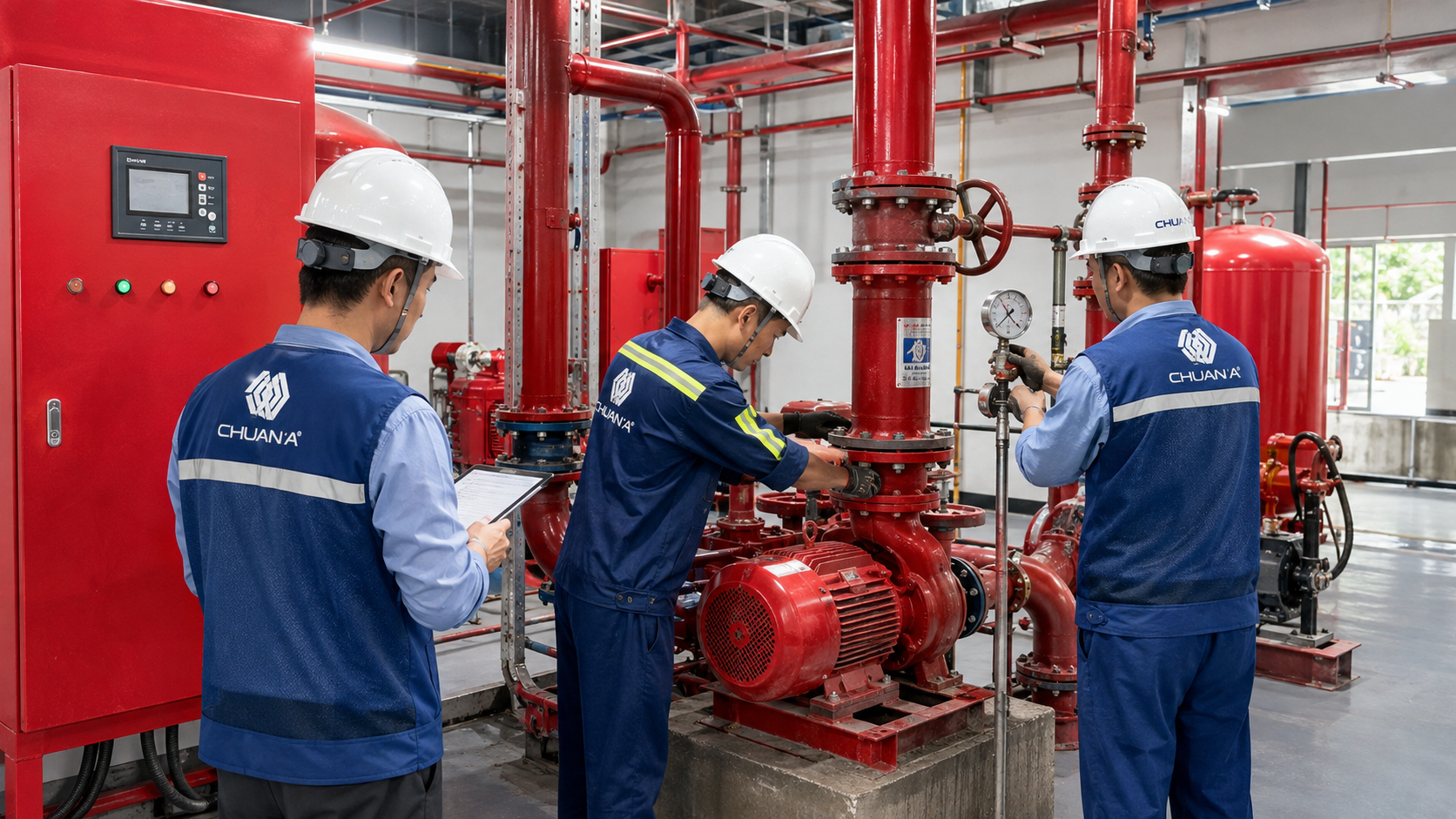
Inspection covers electric pumps, diesel pumps, jockey pumps, control panels and automatic start capability when pressure drops.
Diesel pumps additionally require checks on fuel, starting batteries, cooling systems and oil condition. Periodic test running is the only way to confirm a pump will still start.
(1).png)
Checks cover stored water level, make-up valve condition, tank wall leakage and the ability to sustain design flow rates.
Where tanks serve multiple purposes, the volume reserved for firefighting must be protected from other consumption.
This is the most frequently overlooked group. Items include pipe corrosion, supports, leakage at joints and, critically, the open or closed position of isolation valves.
An isolation valve closed during repair work and never reopened is a common error that disables every branch downstream of it.
Sprinkler heads should be checked for dust accumulation, accidental overspray from painting, obstructions below and signs of corrosion.
Clearance beneath each head must be maintained. Stacking goods too high, or adding ceilings and partitions later, can alter the protected area from what was originally designed.
Checks cover hose condition, couplings, nozzles, landing valves and whether the cabinet can be opened when needed.
Hoses should be unrolled periodically to identify rot, splits or sections stuck together from prolonged folding.
Items include gauge pressure, tamper seals, inspection validity dates, cylinder condition and mounting location.
Extinguishers must remain in their designated positions, unobstructed by stored goods, with signage clearly visible from walkways.
Control panels, smoke detectors, heat detectors, manual call points and alarm sounders require periodic signal testing.
Detectors in dusty areas need more frequent cleaning, since accumulated dust causes false alarms while also reducing sensitivity to real fire conditions.
Checks cover backup batteries, the duration of illumination during power loss and the visibility of exit signage.
Battery life is finite and deteriorates silently, so this can only be verified through a power isolation test.
Inspection covers whether walkways are obstructed by stored goods, whether exit doors open from inside and whether panic bars operate correctly.
This group changes continuously with production activity and therefore requires higher inspection frequency than equipment items.
Fire doors, fire dampers in ductwork, penetration seals at wall crossings and smoke extraction systems all need functional checks.
Openings created later for additional pipework or cabling are frequently left without proper fire sealing.
Visual items such as extinguishers, escape routes and hose cabinets are commonly checked monthly.
Items requiring functional testing, including fire pumps, alarm systems and emergency lighting, are typically quarterly or annual, depending on applicable regulations and manufacturer recommendations.
Each inspection round should be recorded with the date, items checked, findings and corrective actions taken.
These records support internal management and serve as the documentation presented during regulatory inspections.
Many fire protection components are installed at height or connected to other technical systems, so they can be inspected alongside ventilation and electrical works.
Schedule coordination is discussed in our article on factory M&E maintenance. New installations and system upgrades are covered separately in our article on fire protection system installation.
Factory fire protection maintenance differs from all other maintenance work because defects never reveal themselves through normal operation.
Fire pumps, water supply, pipework and valves, sprinkler heads, hose cabinets, extinguishers, alarm systems, emergency lighting and escape routes all require scheduled inspection with complete record keeping. This is the one area where an omission produces no warning signs at all until the system is genuinely needed.
A site survey identifies which items require servicing, where the installation has diverged from the original design and which areas should be prioritised.
CHUAN A CONSTRUCTION INVESTMENT CORPORATION
Address: Amata Industrial Park Service Centre, Long Binh Ward, Dong Nai Province, Vietnam.
Hotline: 0907 494 549
Email: info@chuana.com.vn
Website:https://chuana.com.vn/
Contact Chuan A to discuss fire protection system surveys and maintenance for factories in Dong Nai.


