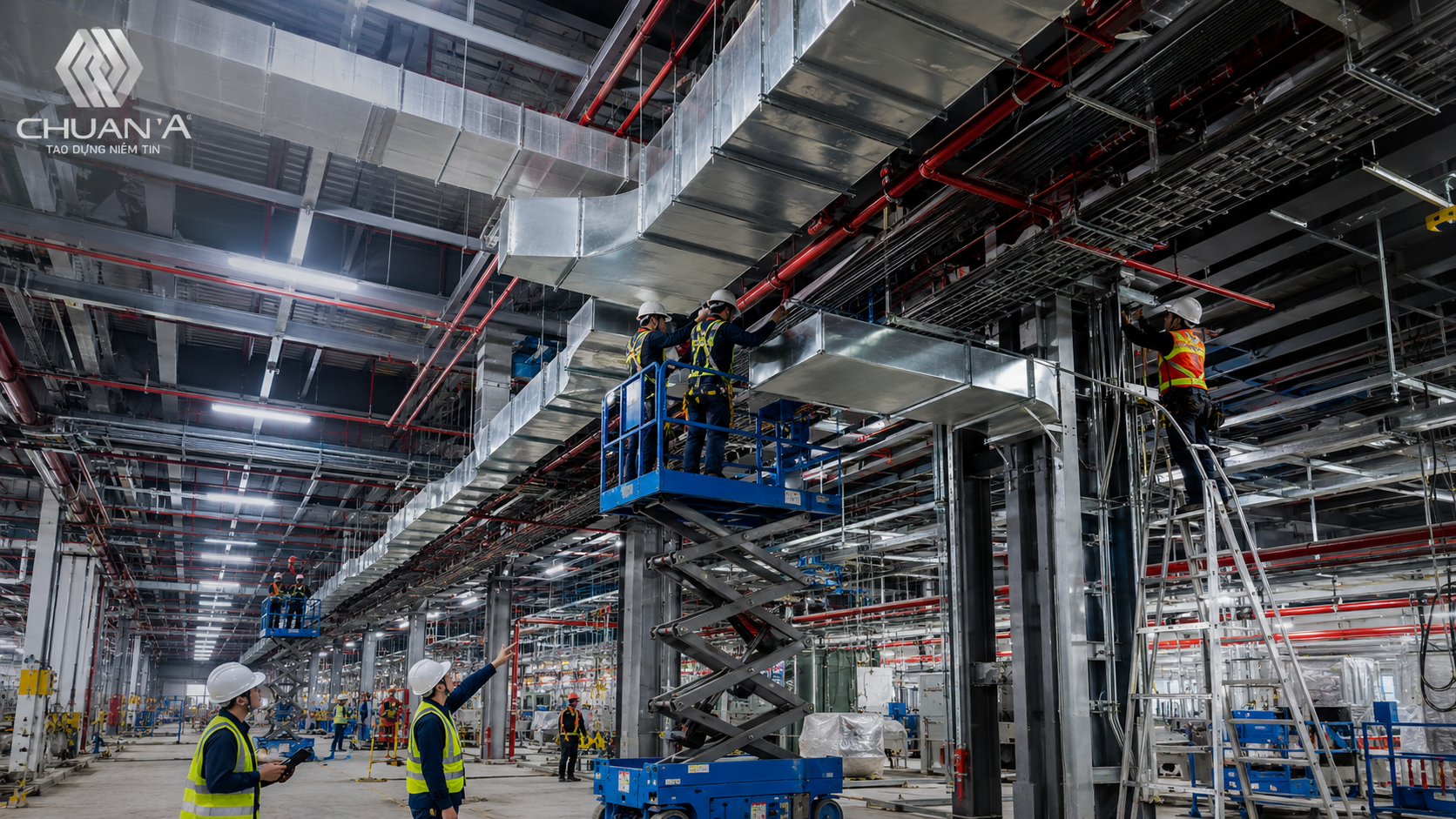
Factory M&E systems are the technical foundation that determines the stable operation of the entire facility. If the structure gives the factory its physical form, M&E is the hidden network that keeps the factory running every day. Electrical systems, lighting, plumbing, ventilation, air conditioning, compressed air, auxiliary systems, and fire protection all directly affect production performance.
A factory may look well-built, but if its M&E systems are not properly integrated, operational problems can appear quickly. Electricity may be overloaded, ventilation may be insufficient, pipes may be difficult to maintain, lighting may be unsuitable, or fire protection may conflict with other technical systems. Therefore, M&E design and installation should begin early, not be handled at the final stage of the project.
.png)
M&E affects almost every production activity. Electrical systems supply power for machinery, lighting, and office equipment. Ventilation and cooling systems help stabilize the working environment. Plumbing supports production, sanitation, and operation. Fire protection must work with electricity, water, alarm systems, and pumps.
For manufacturing businesses, stopping machines for one hour may cost much more than repairing equipment. Therefore, proper M&E investment is an investment in stability. A good M&E system helps factories reduce risks, save energy, extend equipment life, and create a safer working environment.
A factory M&E system usually includes power distribution, lighting, low-voltage systems, network systems, cameras, water supply, drainage, water treatment, ventilation, air conditioning, compressed air, pumps, fire alarm systems, and firefighting systems. Depending on the industry, additional systems may include steam, dust extraction, exhaust treatment, cold storage, or automation control.
Each system has its own requirements, but they must not be designed separately. Ventilation ducts should avoid conflicts with cable trays and fire pipes. Electrical panels should be located in safe and accessible positions. Lighting systems should meet production requirements without wasting energy.
.png)
It is impossible to design a good M&E system without understanding how the factory will be used. A mechanical workshop requires different power capacity and ventilation from a logistics warehouse. A food factory requires different sanitation, temperature, and plumbing conditions from a garment factory. A cold storage facility has special requirements for insulation, electricity, condensate drainage, and temperature control.
Before design begins, it is necessary to define machine capacity, number of devices, production line positions, number of workers, operating hours, temperature requirements, humidity, lighting needs, and expansion potential. A good M&E design is one that understands how the facility will operate in real life.
The electrical system is one of the most sensitive parts of M&E. A small error can stop machines, damage equipment, or create fire risks. Electrical design must calculate load, power distribution, electrical panels, cable routes, grounding, lightning protection, overload protection, and maintenance access.
Factories should have a clear electrical zoning plan. Production areas, offices, warehouses, outdoor lighting, pumps, fire protection, and auxiliary equipment should be organized clearly. When an incident occurs, the technical team can isolate the affected area quickly instead of checking the entire system.
Many factories face heat, poor airflow, dust, or odor because ventilation is not calculated correctly. A poor working environment reduces productivity, increases fatigue, and affects machinery life. Ventilation systems should be based on area, ceiling height, heat sources, worker density, machinery type, and production requirements.
Installing more fans is not always the best solution. The airflow must be reasonable, supply and exhaust points must be properly arranged, and dead zones must be avoided. In some industries, air conditioning or local cooling may be necessary to ensure product quality.
Factory plumbing does not only serve sanitation. It may be related to production, cooling, wastewater treatment, fire protection, and equipment operation. The design must calculate flow rate, pressure, pipe routes, manholes, slope, maintenance access, and expansion potential.
A poor drainage system may cause yard flooding, damp floors, damaged goods, and unsafe conditions. For factories with production wastewater, the treatment solution must be carefully calculated to ensure stable operation.
Fire protection is closely connected to M&E. Fire pumps need stable power, firefighting pipes must coordinate with technical pipelines, fire alarm systems need signal cables and control panels, and emergency lights need suitable power supply. If M&E and fire protection are designed separately, site conflicts are very likely.
Chuẩn A emphasizes an integrated approach between industrial construction, M&E, and fire protection to reduce construction conflicts and improve operational stability. This is important for factory projects that require clear schedules and timely handover.
M&E systems are essential for every modern factory. A good M&E solution helps businesses save energy, reduce technical risks, improve operational performance, and create a safer working environment. With a focus on integrated industrial construction, M&E, and fire protection, Chuẩn A can support businesses in designing, constructing, and completing technical systems for factories.
CHUAN'A CONSTRUCTION INVESTMENT JOINT STOCK COMPANY


