In the contemporary era of rapid industrialization and global supply chain reconfigurations, manufacturing plants and production facilities in Vietnam demand more than just optimized machinery and smart management systems. They require absolute structural safety and high durability from their physical infrastructure. Among these architectural components, the factory floor represents the asset subjected to the most intense operational stress.
A manufacturing factory floor is the ground zero for multi-ton mechanical vibrations, high-frequency structural loads from heavy forklifts, and continuous pallet jack traffic. Simultaneously, this surface is regularly exposed to aggressive chemical infiltrations, including industrial oils, synthetic lubricants, harsh chemical detergents, and microscopic abrasive dust generated during manufacturing processes. If left unprotected, a raw concrete floor will quickly suffer from surface delamination, creating structural concrete wear, creating fine airborne concrete dust that contaminates finished products, and presenting severe operational hazards.
Consequently, industrial plant epoxy floor coating has evolved into a mandatory engineering specification for modern industrial facilities. A certified epoxy floor asset does not merely offer superior mechanical impact resistance, chemical cross-linking durability, and anti-abrasion barriers; it fundamentally transforms the workspace. By establishing a high-gloss, ultra-clean surface, it maximizes ambient light reflectivity from LED systems, significantly reducing corporate energy consumption and fostering a professional, high-performance workspace.
In this technical feature, we present a transparent, data-driven look at an active construction site via our Daily Field Progress Log dated June 23, 2026, at a high-tech manufacturing plant project, while exploring the structural technologies that guarantee long-term asset protection.
To successfully meet the rigid project handover deadline established with the client for June 30, 2026, the project management division and certified flooring technicians executed multi-tiered substrate preparation stages simultaneously. Documenting and analyzing daily operational logs remains instrumental in neutralizing potential substrate failures prior to polymer application.
Liquid epoxy resins and curing polymer coatings are exceptionally sensitive to ambient environmental variables during their application and chemical cross-linking (curing) phases. Microscopic dust particles carried by wind currents from adjacent production zones can compromise an un-cured epoxy film, causing surface cratering, pitting, or premature film delamination.
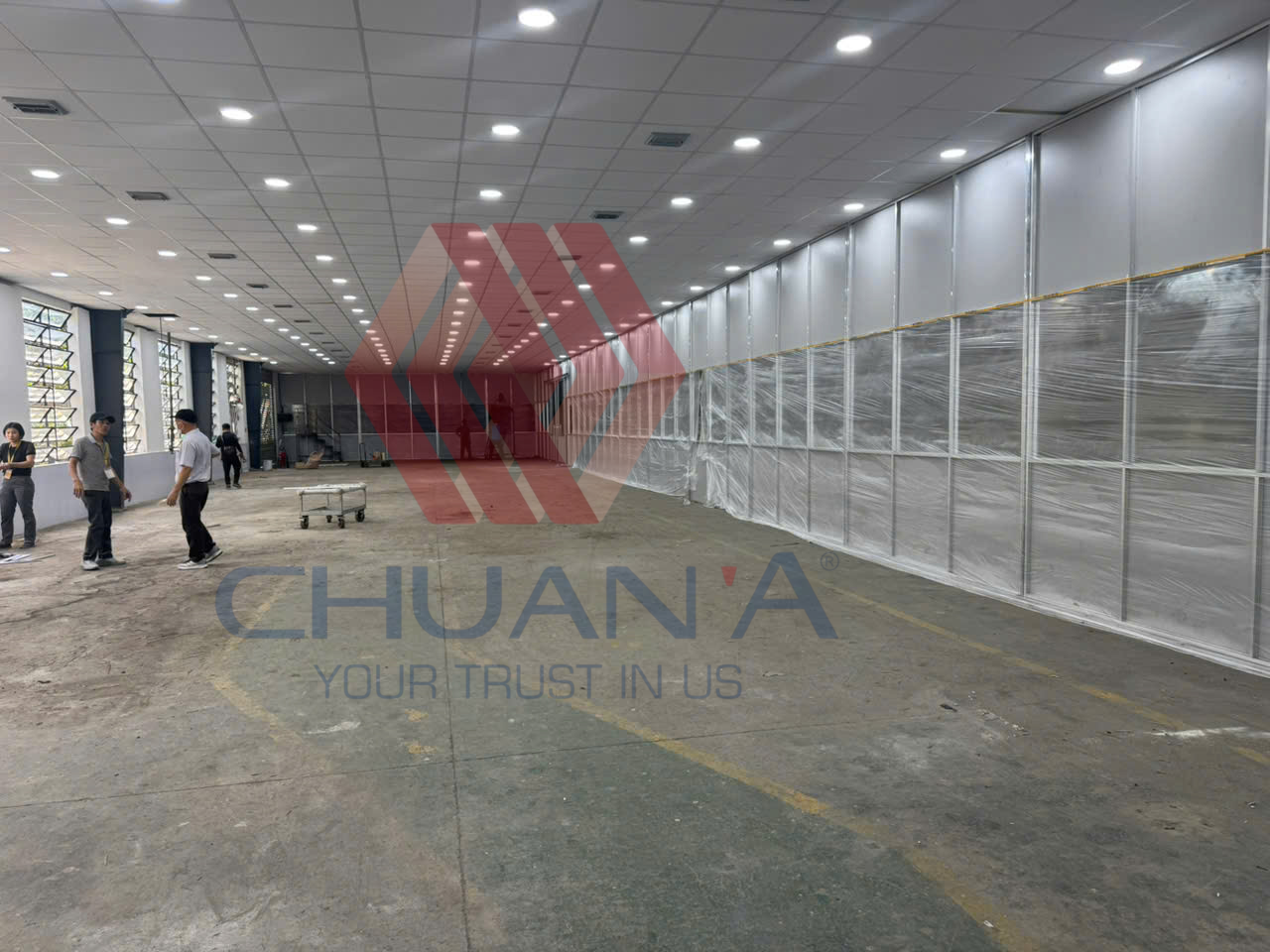
Therefore, early in the morning on June 23, the team prioritized complete site enclosure and isolation. High-density, dust-impermeable vinyl curtains were installed from the ceiling to the floor around the targeted zone. This containment framework offers dual advantages: it preserves the chemical purity of the active coating zone from external airborne particles, while fully containing the concrete dust generated by grinding machinery, preventing contamination of operational production zones or nearby administrative offices.
Before deploying heavy planetary machinery, the raw concrete slab must be cleared of physical impediments. Technicians conducted a comprehensive sweep to collect industrial waste, scrap formwork, tie wires, and welding slag remnants left behind by primary construction activities.
Clearing coarse debris allows the site engineering inspectors to directly audit the base concrete slab's geometry. This process reveals deep structural defects, including micro-cracks, localized pitting, or pre-existing oil saturations, allowing the team to apply custom engineered repair solutions.
This crucial phase represents the core of the substrate preparation workflow, dictating up to 80% of the long-term chemical adhesion between the epoxy matrix and the concrete slab. Newly poured or unmanaged concrete typically retains a weak, brittle top layer known as laitance (dead cement paste). Applying resin formulations directly onto laitance leads to catastrophic coating failure and delamination under heavy vehicle stress within months.
To eliminate this weak interface, our technical team operated heavy-duty three-phase planetary concrete grinding machines configured with industrial diamond segments. This mechanical abrasion process achieves three essential engineering metrics:
It completely grinds away the weak laitance and surface contaminants.
It planes down localized elevation anomalies, ensuring an even, uniform surface across the plant.
It profile-scratches the surface, opening the underlying concrete capillary networks. Opening these concrete pores allows the penetrating Epoxy Primer to infuse 1 to 2 mm deep into the concrete block, creating an unbreakable mechanical-chemical interlock.
Optimizing daily operational yields requires a strategic synergy between experienced field technicians and specialized machinery.
Manpower Deployment: The site operation was led by 01 Senior Technical Site Supervisor supported by 05 certified industrial flooring technicians. The supervisor managed real-time concrete moisture testing with digital moisture meters, monitored surface profiles, calibrated automated component mixing ratios, and ensured strict code compliance. The technician crew was divided into specialized roles: planetary grinder operators, HEPA vacuum technicians, and enclosure/patching crews.
Machinery and Technology Fleet: The mobile engineering unit at the factory deployed advanced equipment, including:
Three-Phase Heavy Planetary Grinders: Engineered to provide consistent downward grinding pressure, achieving international CSP (Concrete Surface Profile) standards.
Industrial HEPA Vacuum Extractions: Integrated directly with the grinding equipment to capture up to 99% of airborne dust at the point of origin, protecting technician health and preventing dust migration.
High-Torque Chemical Mixers: Ensuring that Component A (epoxy resin) and Component B (hardener) achieve complete molecular homogeneity, preventing localized soft spots or incomplete curing caused by manual mixing errors.
Regulated Power Distribution Units & Heavy-Duty Power Lines: Providing safe, uninterrupted power delivery to high-voltage equipment, eliminating voltage drops and operational downtime.
To provide complete transparency regarding the subsequent phases following today's substrate grinding, we outline the standardized 4-step engineering protocol below:
Phase 1: Substrate Analysis (Moisture & Compressive Strength): The concrete slab must possess a minimum compressive strength of 250 Grade (approx. 25 MPa) and include an intact under-slab vapor barrier. The moisture vapor emission rate must test below 5% to prevent osmotic blistering and coating failure.
Phase 2: Micro-Dust Evacuation & Patching: Following the grinding stage (CV3), the floor undergoes industrial HEPA vacuuming. Technicians then apply a high-strength, two-component thixotropic epoxy mortar mixed with quartz silica to seal all micro-cracks and pinholes, producing a perfectly level surface.
Phase 3: Deep-Penetrating Primer (Epoxy Primer) Application: A low-viscosity, deep-penetrating epoxy primer is applied. This coat seals the concrete capillaries, blocks minor moisture migration, and structurally reinforces the concrete surface layer.
Phase 4: High-Performance Topcoat Application: Depending on design parameters—either a high-build roller system (2 coats) or a heavy-duty self-leveling system (1mm to 3mm thickness)—the final pigmented layers are applied. Re-coat windows are strictly maintained between 4 to 8 hours to achieve optimal cross-linking of the polymer chains.
At the close of operations on June 23, 2026, the volume targets for substrate preparation (enclosure, cleaning, and diamond grinding) were fully met. This provides a strong foundation for the primer application scheduled for tomorrow. Backed by rigorous hourly progress monitoring, we confidently affirm that the project will achieve successful handover to the client on June 30, 2026, as scheduled.
Meeting handover milestones underscores our commitment to engineering excellence. It minimizes client operational downtime, allowing rapid assembly line installation to achieve international audit compliances including ISO, GMP, and HACCP standards.
CHUAN'A CONSTRUCTION INVESTMENT JOINT STOCK COMPANY


