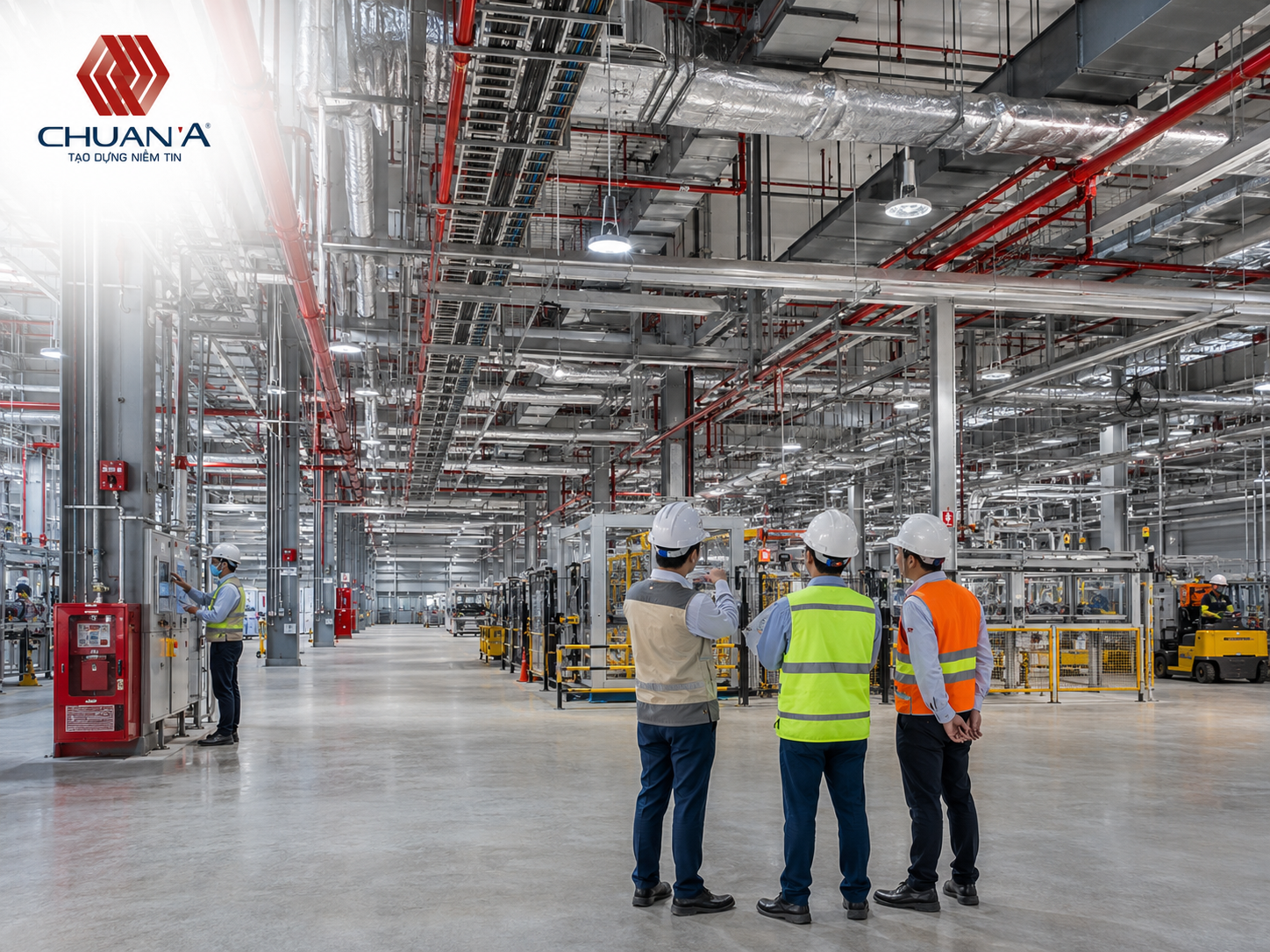
Industrial construction in 2026 is entering a new stage where factories are no longer just buildings for machinery and storage. A modern factory must be an integrated operating system that improves production efficiency, saves energy, ensures fire safety, supports future expansion, and meets the increasing standards of both local and international business partners.
As industrial zones in Dong Nai, Binh Duong, Ho Chi Minh City, and other key economic regions continue to develop, investors are paying more attention to long-term industrial construction solutions. A well-built factory does not only help a business start production faster. It also supports stable operation, reduces maintenance costs, improves brand image, and creates advantages when the business expands.
(1).png)
In the past, many factory projects began with questions such as how many square meters should be built and how much each square meter would cost. In 2026, this approach is no longer enough. Investors need to start with more important questions: how the factory will operate, where production lines will be placed, how forklifts will move, where materials will enter, where finished goods will exit, and how technical systems will support production.
Function-based design helps avoid wasted space. Production areas, raw material warehouses, finished goods warehouses, technical rooms, management offices, restrooms, yards, and internal roads must be arranged according to an efficient operating flow. When the layout is calculated correctly from the beginning, businesses can reduce movement time, limit conflicts between people and vehicles, improve productivity, and reduce accident risks.
This is why modern industrial construction contractors need to understand not only construction, but also factory operation. A drawing may look good, but if it does not fit real production, the business may need to modify the facility after handover. In contrast, a design based on actual function will serve the business better for many years.
Pre-engineered steel buildings remain a major trend in industrial construction in 2026. Many investors choose this solution because it offers faster construction, wide open spaces, easy expansion, and suitability for many facility types, including factories, warehouses, logistics centers, production workshops, plants, and supporting buildings.
With pre-engineered steel buildings, steel components are designed and fabricated in a factory, then transported to the construction site for installation. This process shortens on-site construction time, reduces dependence on weather, and improves component quality control. For businesses that need to start operations quickly, this is a major advantage.
However, a pre-engineered steel building is only effective when load, height, span, bracing systems, roofing, wall cladding, doors, ventilation, M&E, and fire protection are properly designed. If investors choose only based on low price without reviewing technical configuration, the facility may face heat, noise, leakage, expansion difficulty, or poor fit with production lines.
(2).png)
M&E systems determine the operational capability of a factory. Power supply, lighting, plumbing, ventilation, air conditioning, compressed air, cameras, network systems, control systems, and auxiliary utilities all directly affect production. If M&E is handled too late, the project can easily face conflicts with structure, ceilings, walls, pipes, and machinery layout.
The 2026 trend is to integrate M&E from the overall design stage. Cable trays, air ducts, water pipes, electrical panels, lighting fixtures, ventilation equipment, and maintenance access are planned together with architecture and structure. This makes the facility cleaner, easier to operate, and less expensive to adjust during construction.
A good M&E system should not only meet current capacity requirements but also consider future expansion. If the business plans to add machinery, expand production lines, or enlarge storage areas, electrical, water, compressed air, and ventilation systems should include suitable reserves. This preparation helps avoid demolition, rewiring, or system replacement during future expansion.
Fire protection in modern factories cannot be treated as an add-on at the end of the project. In industrial environments, fire and explosion risks may come from electrical systems, machinery, flammable materials, chemicals, dust, heat, warehouses, and continuous production. Therefore, fire protection must be considered from the initial design stage.
A suitable fire protection system must be based on factory function, stored material types, warehouse height, goods density, production layout, escape routes, water supply, pump locations, sprinklers, detectors, extinguishers, and alarm systems. When fire protection is coordinated early with M&E and structure, the project can reduce construction conflicts and make acceptance smoother.
In 2026, many businesses also pay more attention to fire protection maintenance after handover. Even a well-installed fire protection system can lose effectiveness over time if it is not inspected regularly. Therefore, the new trend is to treat fire protection as a complete lifecycle: design, construction, acceptance, operation, maintenance, and upgrading when functions change.
Operating cost is becoming a major concern for investors. A factory that consumes too much electricity for lighting, cooling, ventilation, or auxiliary systems will create long-term cost pressure. Therefore, industrial construction in 2026 is moving toward energy-efficient factory design from the beginning.
Common solutions include using natural light appropriately, arranging effective ventilation, selecting roofing and wall materials that reduce heat, using energy-saving lighting, optimizing building orientation, adding greenery, and considering renewable energy solutions where suitable. For large factories, even a small monthly reduction in energy cost can create significant savings over many years.
Energy efficiency does not mean reducing comfort or lowering quality. On the contrary, a well-designed factory can save electricity while creating a brighter, cooler, and more stable working environment for employees.
The factory floor may look simple, but it directly affects operation. For facilities using heavy machinery, forklifts, high racks, or vibrating production lines, the floor must be designed with proper load capacity, flatness, surface durability, and crack resistance.
In 2026, investors are paying more attention to industrial floor quality. A good floor helps forklifts move smoothly, reduces dust, makes cleaning easier, improves safety, and protects goods. In contrast, cracked, sunken, dusty, or uneven floors can seriously affect production, especially in logistics warehouses or factories with high technical requirements.
Therefore, when building a factory, investors should provide clear information about machinery type, goods load, forklift density, warehouse areas, and operating standards. The contractor should use this data to propose suitable foundation, concrete, coating, and expansion joint solutions.
A modern factory is not limited to four walls. External infrastructure such as internal roads, yards, container areas, stormwater drainage, water supply, electricity, lighting, fences, gates, guard houses, and greenery also affects operation. If infrastructure is not integrated, logistics and production activities will face many difficulties.
Internal roads must be wide enough for trucks, containers, or forklifts to move safely. Yards must have proper load capacity and drainage. Gates must support vehicle flow and security control. Drainage systems must prevent local flooding during rainy seasons. Outdoor lighting must support safe night operation.
The 2026 trend is to view internal infrastructure as part of production efficiency. When vehicles move smoothly, goods flow faster, and yards avoid congestion, businesses save time and operating costs.
The office inside a factory is no longer a temporary supporting area. It is the workplace for management, engineering, planning, human resources, accounting, quality control, and partner reception. A well-designed factory office improves management efficiency, strengthens corporate image, and creates a more professional working environment.
The current trend is to connect factory offices properly with production areas while maintaining cleanliness, quietness, and safety. Glass partitions, meeting rooms, open workspaces, technical rooms, document storage, pantry areas, and reception spaces are arranged more scientifically. For businesses that regularly welcome customers or international partners, a professional factory office is an important advantage.
The office must also be fully integrated with M&E and fire protection. Electrical systems, networks, air conditioning, lighting, escape routes, detectors, and extinguishers should be designed together with the overall factory to ensure function and safety.
As industrial projects become more complex, investors increasingly choose turnkey construction or main contractor models to reduce the number of management contact points. A company that can handle consulting, design, factory construction, office construction, M&E, and fire protection can make the project more organized.
The benefits of turnkey construction include reducing conflicts between disciplines, improving schedule control, and creating a clear responsible contact point. If the investor hires many separate companies, they must coordinate construction schedules, drawings, materials, acceptance, and issue handling by themselves. This can create significant pressure, especially for businesses without a specialized project management team.
Chuẩn A focuses on integrated industrial construction solutions, from consulting and design to factory construction, office construction, M&E, and fire protection. This approach fits the 2026 trend, where investors need facilities that are not only completed, but also operate well.
The manufacturing market changes quickly, so a modern factory must be ready for expansion. A business may begin with a moderate scale, then add production lines, expand storage, build more offices, or add supporting areas. If the initial design does not consider this, future expansion costs can become very high.
Expansion capability should be considered in structure, foundation, electrical and water infrastructure, M&E, fire protection, internal roads, and land use. For example, if the factory may be extended later, column positions, walls, roofs, doors, and technical systems should be arranged accordingly. If the business expects to increase machine capacity, the electrical and ventilation systems should also include suitable reserves.
A facility with expansion vision helps businesses respond more flexibly to market demand. This is especially important for growing manufacturers.
Investors should begin by clearly defining production goals, capacity, machinery type, warehouse needs, workforce, technical requirements, and future expansion plans. The clearer the input information, the more accurate the design solution will be.
Next, investors should choose a contractor with industrial construction experience. The contractor should not only know civil construction, but also understand M&E, fire protection, infrastructure, operation, and acceptance procedures. A contractor with integrated capability can reduce changes and management pressure for the investor.
Businesses should also avoid comparing quotations only by total cost or price per square meter. It is necessary to review the work scope, materials, technical standards, schedule, warranty responsibility, handover documents, and post-project support. A low price with missing work items or unclear quality can increase real costs later.
Chuẩn A focuses on turnkey industrial construction solutions, including consulting, design, factory construction, office construction, M&E, and fire protection. These are the core work items of a modern factory, where all systems must be coordinated from the beginning.
For projects in Dong Nai, Binh Duong, and nearby areas, Chuẩn A can support investors in developing facilities that fit real operating needs. From survey, planning, design, and construction to completion, an integrated approach helps businesses control schedule, quality, and cost more effectively.
What are the most important industrial construction trends in 2026?
Major trends include operation-focused design, pre-engineered steel buildings, early M&E and fire protection integration, energy efficiency, integrated infrastructure, and turnkey construction.
Does a modern factory have to use pre-engineered steel?
Not always, but pre-engineered steel is popular because of fast construction, wide space, and easy expansion. Depending on function, the contractor may recommend steel structure, reinforced concrete, or a combined solution.
Why should M&E and fire protection be integrated from the design stage?
Because M&E and fire protection are directly related to structure, ceilings, walls, production layout, and operation. If handled too late, they can cause conflicts, additional costs, and schedule delays.
Industrial construction in 2026 is not only about building quickly or reducing initial costs. The new trend is to develop modern, integrated, safe, energy-efficient, and expandable factories. Investors should view the facility as a long-term operating system where architecture, structure, M&E, fire protection, and infrastructure all serve production goals. With experience in industrial construction, Chuẩn A can support businesses in factory, manufacturing plant, and technical facility projects in Dong Nai, Binh Duong, and nearby areas.
CHUAN'A CONSTRUCTION INVESTMENT JOINT STOCK COMPANY


