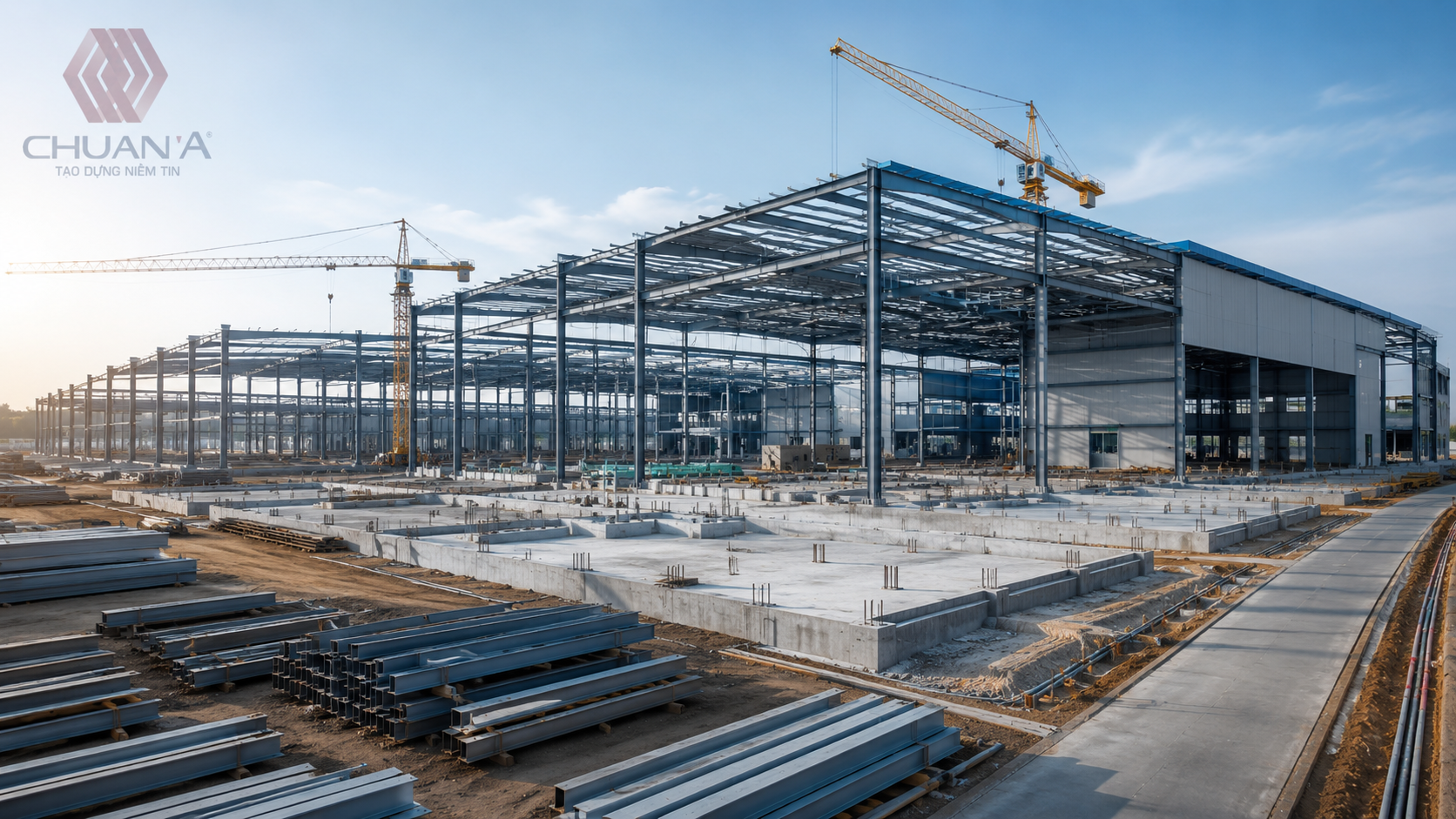
Industrial construction quotation is one of the first things investors ask for when preparing to build a factory, manufacturing plant, logistics warehouse, industrial office, or technical facility. However, industrial construction cost cannot be accurately defined by one general number for every project. Each facility has different function, area, structure, site condition, M&E system, fire protection requirements, and operating needs, so each quotation will also be different.
Many investors begin by asking how much it costs to build a factory per square meter. This is a reasonable question, but if the decision is based only on square-meter price, the business can easily misunderstand the real cost. A simple light-storage warehouse is very different from a manufacturing plant with heavy machinery, high electrical demand, complex ventilation, and strict fire protection requirements.
Therefore, to read an industrial construction quotation correctly, investors need to understand which factors increase or reduce cost. When these variables are clear, businesses can compare contractors more accurately, avoid being attracted by low prices with missing scope, and control the budget more effectively throughout the project.
.jpg)
Industrial construction is a highly technical field. A facility does not only include basic civil construction. It also includes foundations, structure, industrial flooring, roofing and cladding, M&E, fire protection, yard infrastructure, offices, technical rooms, acceptance documents, and operating requirements after handover. Each part can change the cost.
Two factories with the same area of 2,000 square meters may have very different costs. If one project uses light steel structure, has good soil conditions, simple function, and few technical systems, its cost will be lower. If the other project has heavy machinery, weak ground requiring treatment, high-standard flooring, complex fire protection, many M&E work items, and a tight schedule, the cost will definitely increase.
In other words, an industrial construction quotation is like a technical composition. Area is only the first drumbeat. The real volume of the budget comes from structure, materials, technical systems, site conditions, and operating standards.
Area is the first factor affecting industrial construction quotations. The larger the facility, the higher the total cost because more materials, labor, equipment, and construction time are required. However, a larger area does not always mean a higher unit price per square meter. In some cases, large projects can optimize unit price through material scale and efficient construction organization.
Investors should distinguish between land area, construction area, floor area, office area, yard area, and supporting work item area. A clear quotation should define the calculated scope carefully, avoiding the misunderstanding that everything is included when only the main factory building is priced.
Project scale also affects site organization. Large projects require more management staff, construction equipment, material storage areas, safety planning, and quality control procedures. These elements are all reflected in the cost.
Function is more important than area. A production factory, logistics warehouse, processing plant, mechanical workshop, light storage warehouse, or factory office has completely different requirements. Function determines layout, load, structure, M&E, fire protection, flooring, ventilation, lighting, and infrastructure.
If the facility is used only for light storage, technical requirements may be simpler. But if it is used for production with heavy machinery, continuous lines, heat, dust, chemicals, or flammable goods, the cost will increase because safer and more suitable technical solutions are needed.
Function also affects factory height, span, number of loading doors, warehouse zones, management office, technical rooms, electrical rooms, restrooms, staff rest areas, and supporting spaces. Therefore, before requesting a quotation, investors should describe the intended use clearly.
The foundation is one of the major cost factors in industrial construction. If the site has good soil conditions, suitable ground elevation, and does not require complex ground treatment, foundation cost can be optimized. In contrast, if the ground is weak, prone to settlement, or requires piling, reinforcement, or elevation adjustment, cost will increase significantly.
Industrial facilities often carry large loads from machinery, forklifts, goods, warehouse racks, and structure. Therefore, the foundation solution cannot be chosen by guesswork. The contractor must survey site conditions, review soil condition, and calculate loads to propose the right option.
Investors should not reduce foundation cost carelessly. The foundation is underground and difficult to see after completion, but if problems occur, repairs are complicated and expensive. Saving wrongly on the foundation is like making a paper anchor for a steel ship.
The structure is the load-bearing frame of the facility and directly affects the quotation. In industrial construction, common solutions include steel structure, pre-engineered steel buildings, reinforced concrete, or combined structures. Each solution has different advantages, disadvantages, and cost levels.
Pre-engineered steel buildings are often chosen for factories, warehouses, and projects requiring fast construction. Components are fabricated in a factory and installed on site, shortening construction time. However, cost depends on span, height, load, bracing system, steel standards, protective coating, roofing and cladding, and future expansion requirements.
Reinforced concrete structures may suit facilities that require stiffness, load capacity, or special functional needs. In many projects, the contractor may propose a combined solution to balance cost, schedule, and usability.
Investors should ask the contractor to explain why a structural system is chosen. A lower price is not necessarily optimal if the structure does not fit long-term operation.
Materials can easily change the quotation. For the same roofing, cladding, flooring, doors, walls, or office finishing work item, different material choices create different costs. Materials with higher durability, insulation, corrosion resistance, fire resistance, or special technical performance usually cost more.
In factories, materials are not only for appearance. Roofing sheets, panels, insulation layers, protective coatings, concrete, steel, rolling doors, emergency doors, epoxy flooring, hardener, cables, pipes, and fire protection equipment all affect durability and safety.
When reading a quotation, investors should check material types, technical standards, brands, or origins when necessary. Two quotations may differ because one uses better, thicker, more durable materials or includes more work items. A cheap price with unclear materials is a fog that knows how to dress up as savings.
Industrial flooring can significantly affect cost, especially for facilities with forklifts, heavy machinery, high racks, or strict hygiene requirements. A normal floor has a different cost from a high-load, dustproof, anti-slip, abrasion-resistant, or epoxy-coated floor.
Investors should provide information about goods load, forklift type, movement density, machinery location, warehouse areas, and hygiene standards. Without clear data, the contractor cannot prepare an accurate quotation. After completion, if the floor is unsuitable, repairs can interrupt production.
The floor is where every production activity touches reality. A good floor design helps forklifts move smoothly, goods remain safe, machinery vibrates less, and the working environment stays cleaner. Therefore, flooring should not be treated as just a concrete layer underfoot.
M&E is a group of work items that can significantly change industrial construction quotations. It includes power distribution, lighting, water supply and drainage, ventilation, air conditioning, compressed air, cameras, networks, control systems, and production utilities.
A simple factory may need only basic electrical and lighting systems. But a manufacturing plant with many machines, ventilation requirements, water supply, drainage, local air conditioning, compressed air, or control systems will have higher M&E cost. The higher the electrical capacity, the higher the equipment standard, and the more complex the cable routes, the higher the cost.
M&E cost also depends on future expansion capability. If the investor wants to reserve capacity for future growth, the system must be designed beyond current needs. This may increase initial cost but saves money when expanding later.
Fire protection is mandatory in industrial facilities and has a major impact on budget. Fire protection cost depends on area, function, fire risk, building height, goods density, water supply, fire alarm system, firefighting system, sprinklers, pumps, extinguishers, emergency exits, and acceptance documents.
A warehouse storing flammable goods has different fire protection requirements from a light assembly workshop. A factory with high racks, plastic, paper, fabric, or chemicals may need stronger firefighting systems, more sprinklers, larger pumps, or suitable fire separation solutions.
Investors should view fire protection as a safety investment, not an extra cost. If fire protection is under-calculated or handled late, the project may face revisions, delayed acceptance, and affected operation plans. The quotation should clarify design scope, materials, construction, testing, documents, and acceptance coordination responsibility.
Many industrial construction quotations look low because they do not fully include external infrastructure. However, yards, internal roads, container areas, stormwater drainage, water supply, outdoor lighting, fences, gates, guard houses, and greenery can all significantly affect total cost.
For factories with frequent truck or container movement, yards must have suitable load capacity, internal roads must be wide enough, and turning areas must be reasonable. If infrastructure is not calculated properly, receiving and dispatching goods will become difficult. Repairing yards after the factory is already operating is usually much more expensive and inconvenient.
Drainage is also important, especially in areas with heavy rain. Poor drainage can cause local flooding, affecting goods, flooring, and transport activities. Therefore, when reading a quotation, investors should check whether infrastructure is fully included.
Many industrial facilities do not only include the main factory building. They may also include management offices, meeting rooms, technical rooms, guard houses, restrooms, parking areas, staff rest rooms, auxiliary warehouses, pump stations, or electrical stations. These items all affect the total quotation.
Factory offices can be finished at different levels. A basic working space will cost differently from an office with glass partitions, air conditioning, furniture, network systems, meeting rooms, reception areas, and higher corporate image standards.
Supporting areas do not directly create products, but they support daily operation. If they are missed in the initial quotation, the investor may need to add them later, increasing cost and affecting schedule. A good estimate sees even the small rooms, because sometimes those small spaces keep the factory running smoothly.
Project location affects material transport, labor, equipment, machinery, and site organization costs. A facility located in an industrial park with convenient access roads is different from a project in an area with difficult transport, narrow roads, or truck hour restrictions.
Construction conditions are also important. If the land is wide, empty, easy for material storage, and does not affect existing production, site organization is easier. If the project is a renovation of an operating factory, the contractor must work by stages, reduce dust and noise, ensure safety, and avoid production interruption. This can increase cost.
Projects inside industrial parks may also need to follow specific regulations on working hours, safety, cleanliness, transport, infrastructure connection, and related documents. A contractor with local experience can help investors predict these factors better.
The tighter the schedule, the higher the cost may become. If the investor needs the facility completed quickly for machinery delivery, trial production, or customer orders, the contractor may need to increase manpower, work overtime, organize multiple teams in parallel, order materials faster, or use special construction methods.
A fast schedule is not wrong, but it must come with a realistic plan. If the schedule is pushed too hard without quality control, the project may develop errors. A good schedule balances speed, safety, materials, manpower, and acceptance.
When requesting a quotation, investors should state the desired handover time clearly. The contractor will use that timeline to plan construction and calculate cost accordingly. Sometimes a few weeks of schedule can make the difference between a normal quotation and a sprint quotation where the construction site seems to drink extra-strong coffee.
The most important factor when reading an industrial construction quotation is work scope. Some quotations include only basic construction. Others include design, construction, M&E, fire protection, infrastructure, acceptance documents, and handover. If the scope is not checked carefully, investors can easily compare incorrectly.
It is necessary to clarify whether the quotation includes survey, design, permits or related documents, foundation, structure, roofing and cladding, M&E, fire protection, offices, infrastructure, acceptance, as-built documents, and warranty.
A higher quotation with complete scope may be more realistic than a lower quotation missing many work items. Investors should ask the contractor to clearly present what is included and excluded. Clarity in a quotation is like turning on the lights in a warehouse. It does not make things disappear, but it shows what is really there.
When receiving a quotation, investors should begin with work scope instead of total price. Each item should be checked to see what is included, what is excluded, and what needs further clarification. After that, investors can compare materials, technical standards, schedule, warranty, and contractor capability.
Investors should ask the contractor to explain major items such as foundation, structure, flooring, roofing and cladding, M&E, fire protection, and infrastructure. If any item is unusually low or high compared with general expectations, the reason should be clarified. A professional quotation is not afraid of careful review because it is built on data, not smoke.
In addition, the contractor should not be chosen only because of the lowest price. Investors should consider industrial experience, design capability, construction execution, M&E and fire protection coordination, quality process, schedule, labor safety, and responsibility after handover.
The first mistake is comparing total prices without comparing scope. Two quotations may differ because one includes fire protection, M&E, and infrastructure while the other does not. If only the total amount is reviewed, investors may think they have found a cheaper price but actually miss many important parts.
The second mistake is not checking materials. Different materials can create large differences in cost and facility lifespan. Investors should check steel, roofing sheets, flooring, cables, electrical panels, pipes, fire protection equipment, and finishing materials clearly.
The third mistake is not considering long-term operating cost. A facility that is cheap initially but hot, leaky, hard to maintain, lacking electrical capacity, or difficult for fire protection acceptance may cost the business more later.
The fourth mistake is not clarifying variation conditions. In industrial construction, variations may come from function changes, soil conditions, material changes, schedule requirements, or additional work items. The contract and quotation should explain how these will be handled.
Chuẩn A focuses on integrated industrial construction solutions, including consulting, design, factory construction, office construction, M&E systems, and fire protection. With an overall approach, Chuẩn A can help investors understand work scope, choose suitable solutions, and control budgets more effectively.
For projects in Dong Nai, Binh Duong, and nearby areas, Chuẩn A can accompany investors from requirement survey, solution consulting, cost estimation, construction, to handover. Coordination between construction, M&E, and fire protection helps reduce variations, minimize technical conflicts, and create a stable operating foundation for factories, manufacturing plants, and warehouses.
What factors affect industrial construction quotations?
Quotations depend on area, function, soil conditions, foundation, structure, materials, industrial flooring, M&E, fire protection, infrastructure, offices, project location, schedule, and work scope.
Should investors choose the lowest industrial construction quotation?
No. Investors should not choose only by the lowest price. They need to check scope, materials, technical standards, M&E, fire protection, infrastructure, warranty, and contractor capability to avoid later variations.
How can investors get a more accurate industrial construction quotation?
Investors should provide clear information about area, function, machinery, load requirements, storage needs, M&E requirements, fire protection requirements, desired schedule, estimated budget, and future expansion plans.
An industrial construction quotation is not only a number. It is the financial description of the entire facility. To read quotations correctly, investors should understand cost factors such as function, area, foundation, structure, materials, M&E, fire protection, infrastructure, schedule, and turnkey scope. With integrated industrial construction solutions, Chuẩn A can help businesses develop suitable plans, control costs, and implement factory, manufacturing plant, and warehouse projects safely and efficiently.
CHUAN'A CONSTRUCTION INVESTMENT JOINT STOCK COMPANY


