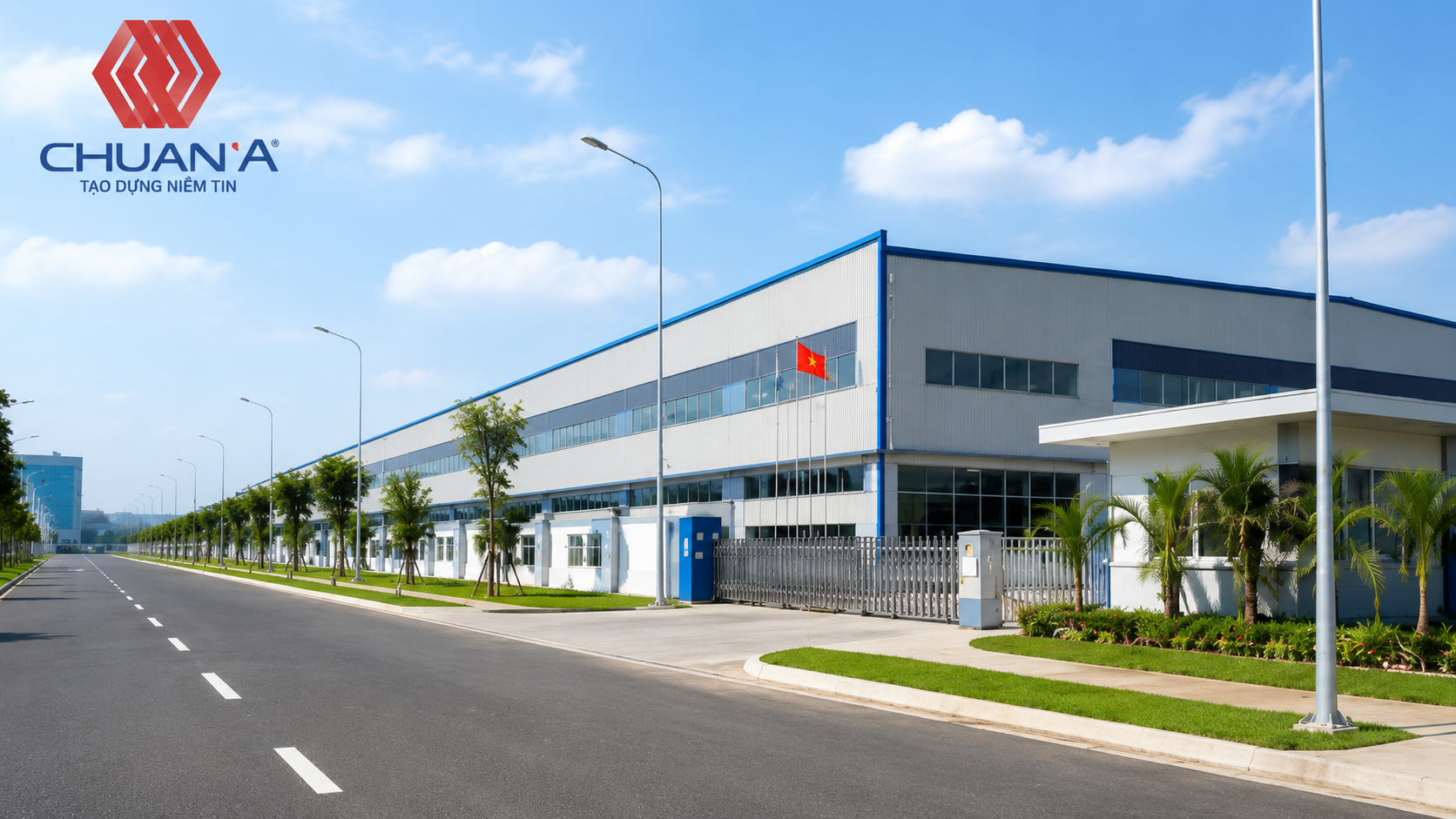
Industrial construction is not only the process of building factories, manufacturing plants, warehouses, or technical facilities. It is also the process of creating a safe production environment where people, machinery, goods, electrical systems, fire protection systems, and infrastructure operate together under control. Therefore, safety standards are always a core factor in industrial project investment.
An industrial facility may be built quickly, may have reasonable costs, and may look modern. But without safety, all of those advantages become fragile. Safety in industrial construction is not limited to the construction stage. It continues throughout the facility’s life cycle, from survey, design, material selection, construction, acceptance, operation, maintenance, to renovation and expansion.
For investors, understanding safety standards helps control the project better, avoid cheap but risky solutions, review quotations more accurately, and work more effectively with contractors. A safe factory protects not only assets, but also production rhythm, corporate reputation, and worker confidence.
Industrial facilities have many characteristics that differ from residential buildings. Factories often have large areas, wide spans, high ceilings, heavy machinery, high-capacity electrical systems, forklifts, stored goods, flammable materials, many workers, and continuous production. Each of these factors can create risks if not designed and managed properly.
A small structural design error can affect building stability. An unsafe electrical route can cause short circuits or fire. A poorly arranged emergency exit can increase danger during an incident. A fire protection system that is not maintained can fail when it is needed most. In industry, risk rarely travels alone. It often brings cost, time loss, human impact, and reputation damage with it.
Therefore, safety should be considered an investment standard, not an extra cost. A safe facility helps businesses operate steadily, reduce production interruptions, meet inspection requirements more easily, and improve professional image with partners.
.png)
Safety begins with drawings, and even before drawings, it begins with the survey stage. The contractor must survey the site, soil conditions, surrounding infrastructure, ground elevation, drainage, access roads, power supply, water supply, and factors affecting construction. If the survey is incomplete, the design may be inaccurate and create risks during construction.
In design, safety must be considered for the entire facility. Architecture must provide a reasonable layout, clear circulation, enough operating space, and safe movement flow. Structure must meet live loads, machinery loads, wind loads, roof loads, and operating conditions. M&E and fire protection must be coordinated from the beginning to avoid technical conflicts.
Safe design is not only design that prevents the building from collapsing. It is also design that allows people to move conveniently, machinery to operate steadily, forklifts to avoid dangerous intersections, electrical systems to be inspected easily, pipes to be maintained conveniently, and fire protection to function properly during an emergency.
A good drawing is like a map that already understands the weather. It does not only show the route. It also warns where the floor may be slippery, where guardrails are needed, and where hidden corners require light.
The structure is the load-bearing frame of an industrial facility. Structural safety involves foundations, columns, beams, trusses, steel frames, slabs, roofs, connections, bolts, welds, and overall load-bearing capacity. If the structure is unsafe, the facility carries serious risks throughout operation.
For factories and manufacturing plants, the structure must be calculated based on actual function. A heavy storage warehouse is different from a light assembly workshop. A plant with vibrating equipment is different from a finished goods warehouse. A facility with continuous forklift movement has different requirements from an area used mainly by workers.
For pre-engineered steel buildings, attention should be paid to steel quality, component specifications, protective coating, bracing systems, bolt connections, welds, installation accuracy, and corrosion resistance. Steel erection also requires control of work at height, lifting operations, and dangerous zones under cranes.
Investors should ask the contractor for drawings, technical explanations, material standards, and structural inspection procedures. Structure is not a place for guessing. It is the backbone of the factory, and a backbone cannot be built by impulse.
(1).png)
Foundations and flooring directly affect building stability and production activity. Foundations must match soil conditions, building loads, and machinery loads. If weak ground is not treated properly, the facility may experience settlement, cracking, or deformation.
Industrial flooring must provide suitable load capacity, flatness, surface durability, dust control, slip resistance, and suitability for production needs. In logistics warehouses, forklifts move constantly, so flooring requires high flatness and durability. In facilities with hygiene requirements, flooring must be easy to clean, low-dust, and suitable for the production environment.
Floor safety is not only about load capacity. A slippery floor can cause workplace accidents. A dusty floor can affect machinery and product quality. A cracked floor can cause forklift vibration, unstable goods, and higher maintenance costs.
Therefore, investors should provide clear information about machinery loads, goods loads, forklift type, movement density, warehouse areas, and hygiene requirements. The clearer the input data, the safer and more suitable the foundation and flooring solution will be.
Electricity is essential but also risky inside factories. Industrial electrical systems usually have high capacity and serve machinery, production lines, lighting, offices, pumps, ventilation, cameras, and supporting equipment. If design or installation is incorrect, risks such as overload, short circuit, fire, explosion, and production interruption increase significantly.
Electrical safety standards must be considered from the M&E design stage. Capacity should meet current needs and include reserves if the business plans to expand. Electrical panels should be placed in accessible, ventilated, safe, and maintainable locations. Cables, cable trays, protective devices, grounding systems, and lighting equipment must be selected according to technical requirements.
During installation, cable quality, joints, electrical panels, switching devices, cable routes, and environmental protection must be checked. After installation, the system should be tested, commissioned, and accepted before operation.
A safe electrical system is like a river with solid banks. It can carry energy throughout the factory, but it must be guided properly so it does not become a flood.
M&E is not only electricity. It also includes water supply and drainage, ventilation, air conditioning, compressed air, cameras, networks, control systems, and production utilities. Each part must be designed, installed, and maintained according to suitable standards.
Water supply and drainage must ensure pressure, flow, stormwater drainage, domestic drainage, and wastewater handling if applicable. Pipes should be arranged clearly, be easy to inspect, reduce leakage risk, and avoid affecting production areas. For facilities with hygiene or chemical requirements, pipe materials and drainage solutions require even more careful consideration.
Ventilation and air conditioning directly affect worker health and production environment quality. A hot, stuffy, dusty, or poorly ventilated factory can reduce performance, increase accident risk, and affect product quality. Therefore, ventilation must be calculated according to function, workforce density, machinery type, and production characteristics.
M&E safety depends on coordination. If pipes, cable trays, ducts, and technical equipment are not coordinated from the beginning, the facility may face conflicts, difficult maintenance, and hidden risks. M&E runs quietly, but when it fails, the entire factory may have to stop and listen to a very expensive silence.
Fire protection is one of the most important safety standards in industrial construction. Factories, plants, and warehouses often have fire and explosion risks from electrical systems, production materials, stored goods, heat-generating machinery, chemicals, dust, or welding and cutting during maintenance.
The fire protection system must be designed based on function, area, height, stored materials, goods density, number of people, emergency exits, water source, pump location, and related requirements. Common work items include fire alarms, detectors, bells and lights, control panels, extinguishers, hydrants, fire pipes, sprinklers, fire pumps, water tanks, emergency lights, and exit signs.
The key point is that fire protection must be coordinated with architecture, structure, and M&E. If handled late, sprinklers may be blocked by racks, pipes may conflict with beams, emergency exits may be affected by production layout, or control panels may be placed in inconvenient locations.
After handover, fire protection systems must be inspected and maintained regularly. Extinguishers, pumps, valves, detectors, sprinklers, water supply, bells, lights, and control panels must be checked to ensure readiness. Fire protection is not a display system. It is the night guard in red, usually quiet but never allowed to fall asleep.
Emergency exits are mandatory in industrial facilities. During fire, power loss, chemical leakage, or other emergency situations, emergency exits help people leave dangerous areas quickly. If emergency exits are poorly arranged or blocked by goods, the consequences can be severe.
Emergency exit design should be based on building area, number of people, function of each zone, travel distance, and safe assembly points. Exit doors, emergency lights, direction signs, corridors, stairs, and assembly areas must be clear, easy to identify, and free of obstacles.
Internal traffic inside the factory must also be planned. Movement flows for pedestrians, forklifts, trucks, and container vehicles should be separated or controlled properly. Blind corners, intersections, turning areas, and loading zones need enough space to reduce collision risks.
A safe factory is a place where people know how to exit when needed, vehicles know where to move during work, and goods do not turn escape routes into a maze. Clear movement is a form of safety.
The working environment inside a factory directly affects worker health, productivity, and safety. Poor ventilation can cause heat, stuffiness, dust accumulation, chemical vapor buildup, or unpleasant odors. Poor lighting can lead to mistakes, increase accident risks, and reduce product quality.
Ventilation systems must be designed based on production function, factory height, workforce density, machinery type, generated heat, and environmental requirements. Some factories need natural ventilation combined with industrial fans. Some areas require dust extraction, heat extraction, or specialized vapor treatment.
Lighting must provide suitable brightness for each area. Main production areas, quality control zones, warehouses, offices, walkways, yards, and technical rooms have different lighting needs. Lights should be arranged to reduce glare, shadows, and dangerous dark zones.
Workplace environmental safety is not a soft side topic. It affects every shift, every operation, and every small decision made by workers. A bright, airy, and visible space reduces errors like a clear lens after dust is wiped away.
Materials and equipment in industrial construction need clear origin, specifications, and quality. From steel, concrete, roofing sheets, panels, cables, electrical panels, pipes, fire protection equipment, to lighting fixtures, every material affects facility durability and safety.
Investors should require contractors to clarify material types, technical standards, documents, brands, or origin where necessary. During construction, incoming materials should be inspected before installation. If unsuitable materials are used, the facility may degrade quickly or carry technical risks.
Especially for M&E and fire protection, equipment must support stable operation. Cables, switching devices, fire pumps, detectors, sprinklers, valves, extinguishers, and safety equipment should not be selected casually only because they are cheaper.
Materials are small bricks of trust. One wrong brick may not collapse the facility immediately, but it can create cracks where future risks enter.
Labor safety during construction cannot be ignored. Industrial construction sites often include lifting equipment, heavy steel structures, work at height, temporary electricity, welding, cutting, vehicles, and many teams working at the same time. Without safety management, accident risks increase.
The contractor must prepare safety plans before work begins. Workers should be equipped with helmets, safety shoes, reflective vests, safety harnesses when working at height, and other suitable protective equipment. Dangerous areas must be fenced, marked with warnings, and supervised.
Work such as steel frame erection, roofing, crane operation, welding, electrical installation, night work, or construction near an operating factory must be controlled carefully. Safety measures should not stay only on paper. They must be implemented on site.
For investors, choosing a contractor with safety awareness is a way to protect schedule and corporate image. A safe construction site not only has fewer accidents, but is often more organized, cleaner, and more professional.
Acceptance confirms that the facility has been built according to design, correct materials, technical standards, and is ready for use. In industrial construction, acceptance should be performed by work item and by stage, not only at the end of the project.
Work items for acceptance may include foundations, structure, flooring, roofing and cladding, M&E, fire protection, infrastructure, offices, technical equipment, and finishing. Stage-by-stage acceptance helps detect errors early, before they are hidden or affect other items.
Handover documents are also part of safety. Investors should receive as-built drawings, acceptance records, material certificates, equipment documents, operation manuals, M&E documents, fire protection documents, and warranty information. Without documents, future maintenance, repair, or expansion becomes more difficult.
A safe facility does not end on the handover day. It continues to live in the documents, in the maintenance schedule, in how operators understand the building, and in the ability to respond when incidents occur.
The first mistake is treating safety as an extra. Some investors focus only on price and schedule, while structure, M&E, fire protection, emergency exits, and maintenance are not carefully checked. This approach may save money at first but creates major risks later.
The second mistake is separating technical work items. If construction, M&E, and fire protection are not coordinated from the beginning, the project can face conflicts. When pipes conflict with structure, electrical panels are misplaced, or sprinklers are blocked, solving the issue costs time and money.
The third mistake is choosing materials based mainly on low price without checking standards. Poor-quality materials can reduce facility lifespan, increase incident risks, and raise maintenance costs.
The fourth mistake is lacking a maintenance plan after handover. Many systems work well at first but degrade over time. Without regular inspection, electrical systems, fire protection, roofing, flooring, ventilation, and technical equipment may become unsafe before the business notices.
Chuẩn A focuses on integrated industrial construction solutions, from consulting and design to factory construction, office construction, M&E systems, and fire protection. This integrated approach allows safety standards to be considered from the beginning instead of being handled separately in each work item.
For projects in Dong Nai, Binh Duong, and nearby areas, Chuẩn A can support investors in building facilities that match production function and coordinate structure, M&E, fire protection, infrastructure, and operation requirements. A safe industrial facility must be created through technical knowledge, experience, and responsibility.
What are the most important safety standards in industrial construction?
Important standards include structural safety, foundation and flooring safety, electrical safety, M&E safety, fire protection, emergency exits, ventilation, lighting, material quality, labor safety, and acceptance documents.
Why should fire protection be designed from the beginning?
Because fire protection is directly related to layout, structure, M&E, water supply, emergency exits, and factory function. If handled late, the project may face technical conflicts, higher costs, and delayed acceptance.
How can investors control facility safety?
Investors should choose an experienced industrial contractor, review quotation scope, request clear drawings, control materials, accept work by stage, and store complete handover documents.
Safe industrial construction is the foundation for a factory, manufacturing plant, or warehouse that operates sustainably. Safety does not belong to one separate work item. It is the result of coordination among survey, design, structure, foundation, flooring, M&E, fire protection, infrastructure, materials, construction, and maintenance. With integrated industrial construction solutions, Chuẩn A can accompany investors in projects that require safety, stability, and long-term operating efficiency.
CHUAN'A CONSTRUCTION INVESTMENT JOINT STOCK COMPANY


