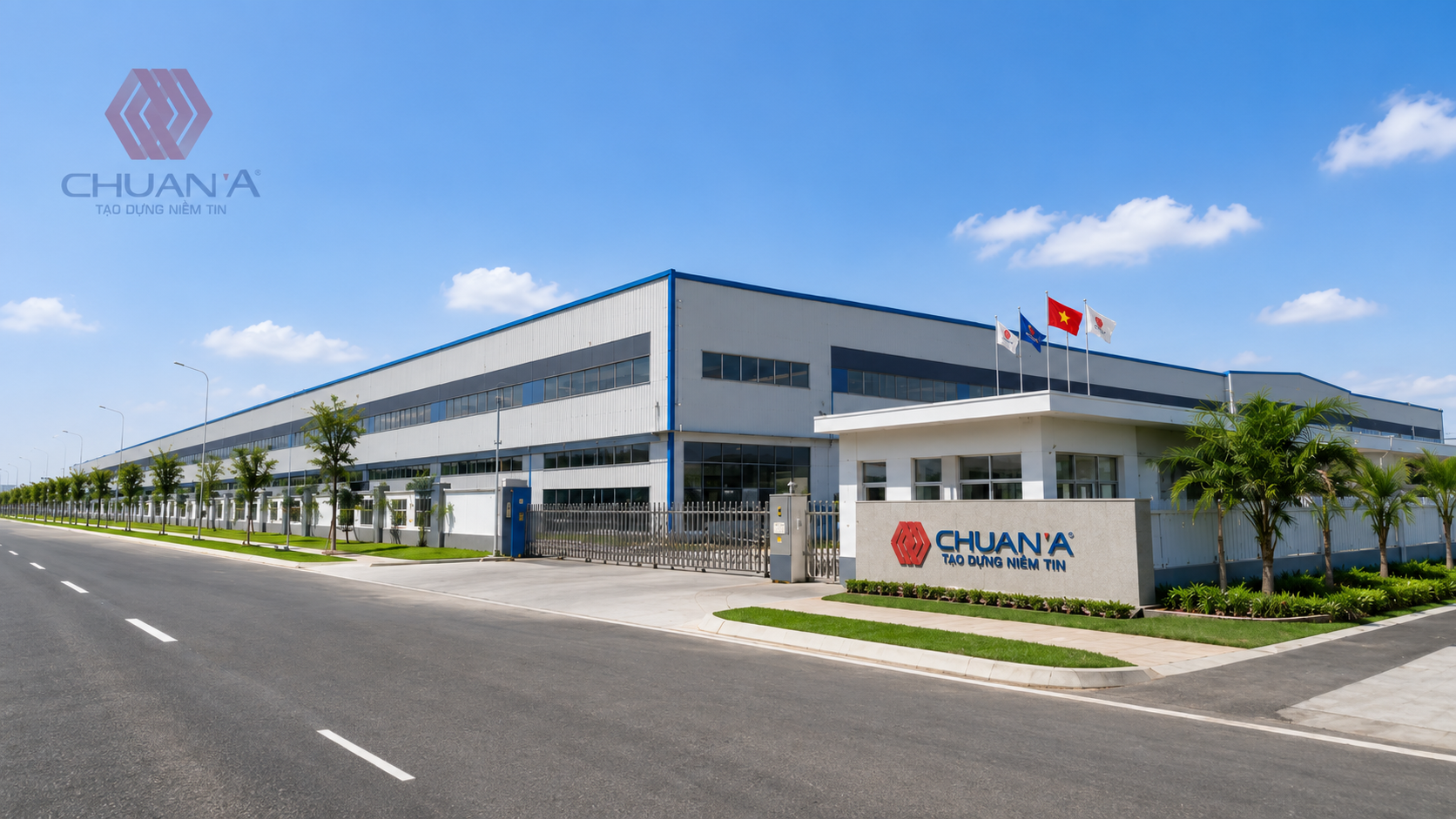
Sustainable industrial construction is becoming an important direction for businesses investing in factories, manufacturing plants, warehouses, and technical facilities. Sustainability in industrial construction does not only mean using green materials or adding trees to the site. It means designing and building a facility that can operate steadily, save energy, reduce maintenance costs, ensure safety, and adapt to future expansion needs.
As operating costs become increasingly important, a good factory should not be judged only by initial construction cost. Investors need to consider the total life-cycle cost of the facility, including electricity, water, maintenance, repairs, upgrades, production interruptions, and expansion capability. A facility that is cheap to build but expensive to operate can become a wallet leaking drop by drop every month.
For businesses in Dong Nai, Binh Duong, and other developing industrial regions, sustainable industrial construction helps improve long-term competitiveness. A well-designed factory supports stable production, creates a safer working environment, improves corporate image, and helps investors respond better when market conditions change.
(1).png)
Sustainable industrial construction is the process of designing, building, and operating industrial facilities in a way that balances investment cost, usability, safety, building lifespan, and environmental impact. A sustainable facility does not necessarily have to be very expensive, but it must be calculated properly from the beginning.
In practice, sustainability can appear in many factors such as efficient layout, suitable structure, adequate floor load, heat-reducing roofing and cladding, good ventilation, energy-saving lighting, maintainable M&E systems, safe fire protection, effective drainage infrastructure, durable materials, and future expansion capability.
Simply put, sustainable industrial construction means building a facility that does not only work today, but continues to serve well for many years. It is like planting a machine-tree of steel and concrete: roots are the foundation, trunk is the structure, veins are M&E, leaves are roof and walls, and shade is long-term operating efficiency.
The first reason is operating cost. In factories and manufacturing plants, electricity, water, cooling, lighting, maintenance, and repair costs can accumulate into a large amount over time. If the facility is poorly optimized, the business will keep paying those costs for many years.
The second reason is production stability. A facility that leaks, overheats, lacks ventilation, has weak flooring, insufficient electrical capacity, or difficult fire protection maintenance can interrupt operation. In manufacturing, each shutdown can affect labor costs, orders, materials, and customer trust.
The third reason is meeting partner expectations. Many companies, especially those in international supply chains, increasingly care about working environment, safety, energy efficiency, and operational responsibility. A well-built factory creates a more professional image when welcoming customers, partners, or inspection teams.
To build sustainably, investors should begin with function. What will the facility produce? Where will machinery be placed? How will goods move? How will forklifts operate? How much storage is needed? How many employees will use the office? Will the facility need expansion later? These questions determine long-term operating efficiency.
A reasonable layout reduces movement time, limits conflicts between people and vehicles, optimizes warehouse space, reduces accident risks, and makes production more organized. In contrast, a poor layout can create daily inconvenience even if the facility looks attractive from the outside.
Sustainable functional design does not mean squeezing as many zones as possible into one site. It means arranging each area according to operating logic. Every square meter should have a clear mission, neither wasted nor too crowded. A sustainable factory is where people flow, goods flow, and technical systems pass through in order, not like a rush-hour intersection.
The structure is the load-bearing frame of the facility. A sustainable structure must match function, loads, soil conditions, height, span, machinery type, and expansion plans. If the structure is underdesigned, the facility may be unsafe. If it is overdesigned, the investor may waste money.
Pre-engineered steel buildings are common in modern industrial construction because they offer fast construction, wide spaces, and flexible expansion. However, for sustainability, steel structures must be designed with correct loads, connections, protective coating, corrosion resistance, bracing systems, roofing and cladding, and real operating conditions.
For facilities with heavy machinery, large loads, or special requirements, the contractor may recommend reinforced concrete or combined solutions. The important point is not choosing the material that sounds more modern, but choosing the solution that best fits the facility’s life cycle.
Factory flooring is continuously affected by forklifts, machinery, goods, workers, and equipment. A good floor supports stable operation, easy cleaning, dust reduction, lower vibration, and goods protection. A poor floor can crack, settle, create dust, become slippery, or wear quickly.
For durable flooring, investors should define goods load, forklift type, movement density, machinery areas, hygiene requirements, and production standards. From there, the contractor can propose suitable concrete, hardener, epoxy, dustproof, anti-slip, or coating solutions.
Repairing floors after the factory has started operation is usually much more expensive than doing it correctly from the beginning because production areas may need to stop, goods may need to be moved, and work must be done under limited conditions. Durable industrial flooring is a quiet foundation, but it decides whether every forklift wheel passes smoothly.
Roofing, cladding, and the building envelope do not only protect the facility from sun and rain. They directly affect indoor temperature, cooling demand, building durability, and working environment. If the roof absorbs too much heat, the factory becomes hotter and cooling costs increase.
Sustainable solutions may include insulation materials, suitable panels, high-quality roofing sheets, heat-reduction layers, roof ventilation, properly positioned daylighting panels, and effective roof drainage. However, natural lighting and heat control must be balanced because too much poorly positioned light can create heat or glare.
A good envelope system makes the facility more comfortable, reduces leaks, reduces heat, and extends lifespan. In a factory, a roof is not only for keeping rain away. It is the lid of a large machine, helping everything inside operate steadily while weather changes shifts outside.
M&E systems strongly influence factory operating efficiency. Power distribution, lighting, water supply and drainage, ventilation, air conditioning, compressed air, cameras, networks, and control systems all need to be designed according to real needs. If M&E capacity is insufficient, the business may face interruptions. If systems are oversized unnecessarily, investment cost may increase.
Sustainable M&E means systems that are sufficient, expandable, maintainable, and energy efficient. Lighting should be arranged according to usage areas to avoid waste. Ventilation should be based on heat, worker density, machinery type, and production characteristics. Water supply and drainage should be clear, leak-resistant, and easy to inspect.
The key is that M&E must be coordinated from the design stage. When electrical routes, water pipes, air ducts, cable trays, and technical equipment are arranged properly, the facility is easier to operate and requires fewer modifications. M&E is like the vascular system of the factory body: when it flows correctly, everything is flexible; when it flows wrongly, the whole body becomes tired.
Fire protection is essential in sustainable industrial construction. A good fire protection system does not only help the facility meet acceptance requirements. It protects workers, machinery, goods, and production continuity.
Fire protection should be designed based on function, area, height, stored materials, goods density, number of people, emergency exits, water source, and operating plan. Common work items include fire alarms, firefighting systems, sprinklers, pumps, extinguishers, hydrants, emergency lights, exit signs, and related documents.
The sustainability of fire protection lies in maintaining effectiveness after handover. The system should be easy to inspect, easy to maintain, well documented, and suitable when function changes. If the factory expands storage or changes stored materials, fire protection should also be reviewed. Safety is not a photograph taken on acceptance day. It is a long film of the entire operation period.
External infrastructure such as internal roads, yards, container areas, stormwater drainage, water supply, outdoor lighting, fences, gates, and guard houses plays an important role in operation. A factory may be well built inside, but if the yard floods or vehicle routes are inconvenient, daily problems will still occur.
Sustainable infrastructure should consider vehicle loads, traffic flow, turning space, drainage, security, and maintenance. Yards need proper slope, load-bearing surface, and effective drainage. Internal roads must be wide enough for trucks, containers, or forklifts to move safely.
In rainy climates, drainage should not be underestimated. A heavy rain can turn a weak yard into a temporary lake, affecting goods movement and transport safety. Good infrastructure is the background music of operation. Few notice it when it works well, but when it fails, the whole factory hears it.
Energy saving is one of the pillars of sustainable industrial construction. Energy-saving solutions can begin with building orientation, ventilation, daylighting, roof and wall materials, lighting systems, M&E equipment, and operating habits.
Factories can use natural daylight reasonably to reduce daytime lighting electricity. Energy-efficient lighting reduces long-term cost. Good ventilation reduces cooling demand. Suitable roof and wall materials limit heat absorption. For some projects, investors may consider solar energy or other energy-saving solutions if appropriate.
The important point is that energy saving must support function. Lighting should not be reduced so much that it affects work. Ventilation should not be uncontrolled in a way that spreads dust or heat. Expensive solutions should not be chosen if they do not fit project scale. Sustainability is long-term wisdom, not an expensive green cape worn for decoration.
Materials in industrial construction should be chosen according to the operating environment. Factories with dust, heat, moisture, chemicals, vibration, or continuous forklift traffic place higher requirements on materials. If unsuitable materials are chosen, the facility can degrade quickly.
Sustainable materials are not always the most expensive materials. They are materials suitable for function, with good lifespan, easy replacement, easy maintenance, and clear origin. Roofing sheets, panels, steel, concrete, paint, cables, pipes, M&E equipment, and fire protection equipment should all be selected according to suitable standards.
Investors should ask the contractor to clarify material types in the quotation. Vague material descriptions can create large differences between quotations and directly affect quality. A correct material in the right place is a silent guard. A wrong material is an invitation for damage.
Manufacturing businesses often change with the market. Today they may need one production line, and a few years later they may need more storage, more machinery, more offices, or a different layout. Therefore, expansion capability should be considered in industrial facility design.
Expansion is not only about leaving empty land. It relates to structure, column positions, factory expansion direction, electrical systems, water systems, ventilation, fire protection, internal roads, and yard infrastructure. If the original systems cannot expand, the business may need to demolish, relocate, or replace many items during upgrades.
A facility with expansion vision gives the business more flexibility. When the market calls, the factory can answer by increasing capacity instead of struggling because the old building has no room to breathe. This is a very practical sustainability value.
Sustainable construction does not end on handover day. After operation begins, regular maintenance is important to maintain quality. Roofs, floors, electrical systems, water supply and drainage, ventilation, fire protection, yards, and technical equipment all need scheduled inspection.
Maintenance helps detect early signs of deterioration such as roof leaks, floor cracks, abnormal electrical heating, weak fire pumps, pipe leaks, poor drainage, or broken lighting. Early detection is usually cheaper than handling major failures.
Investors should store as-built documents, equipment manuals, inspection schedules, and maintenance records. A factory with good documentation is easier to care for, like a patient with clear medical records instead of guesswork every time repair is needed.
Handover documents are an important technical asset of the facility. They usually include as-built drawings, acceptance records, material certificates, equipment documents, operation manuals, M&E documents, fire protection documents, warranty information, and related files.
For industrial facilities, the clearer the documents, the easier operation, maintenance, repair, and expansion become. Without as-built drawings, the business may struggle to find electrical routes, pipes, equipment locations, or the real fire protection scope.
Good documents do not make the facility look better in photos, but they make it easier to live with in reality. They are the technical memory of the factory. Without them, every upgrade becomes a conversation with darkness and the sound of concrete drilling.
The first mistake is focusing only on initial construction cost. A low quotation may look attractive, but if materials are poor, technical systems are hard to maintain, the facility is hot, leaky, or difficult to expand, long-term cost may become much higher.
The second mistake is designing without following function. An unsuitable layout increases movement time, reduces efficiency, and creates operational inconvenience. These issues can last for years if not renovated.
The third mistake is separating M&E and fire protection from overall design. When technical systems are not coordinated from the beginning, the facility can face conflicts, difficult maintenance, and adjustment costs.
The fourth mistake is ignoring expansion. A facility that only meets current needs without development plans can limit the business when demand increases. In manufacturing, room for growth can be as valuable as a secret door opening at the right time.
Chuẩn A focuses on integrated industrial construction solutions, from consulting and design to factory construction, office construction, M&E systems, and fire protection. This integrated approach helps investors view the facility as a complete operating system instead of disconnected work items.
For projects in Dong Nai, Binh Duong, and nearby areas, Chuẩn A can support businesses in building factories, manufacturing plants, warehouses, or technical facilities in a safer, more efficient, and more sustainable way. When function, structure, M&E, fire protection, and infrastructure are considered together, the facility can operate more steadily and adapt better to the future.
Does sustainable industrial construction increase initial cost?
It may increase cost in some work items if better materials, more efficient technical systems, or expansion reserves are selected. However, when life-cycle cost is considered, sustainable solutions can reduce operating, maintenance, and repair costs in the long term.
What factors are most important for sustainable factory operation?
Important factors include functional design, suitable structure, adequate flooring, efficient M&E, safe fire protection, good infrastructure, suitable materials, clear handover documents, and regular maintenance planning.
Why is expansion capability important?
Because production needs may change with the market. If the facility is designed with expansion in mind, the business can upgrade storage, production lines, M&E, or fire protection more easily without excessive demolition or modification.
Sustainable industrial construction is an essential direction for businesses that want to optimize cost and long-term operation. A sustainable facility is not only attractive or inexpensive at the construction stage. It must be safe, energy-efficient, easy to maintain, expandable, and suitable for production function. With integrated industrial construction solutions, Chuẩn A can accompany investors in factory, manufacturing plant, and warehouse projects in Dong Nai, Binh Duong, and nearby areas.
CHUAN'A CONSTRUCTION INVESTMENT JOINT STOCK COMPANY


